Author name: editoradmin

Technician installing Tata Power EZ Charge 7.4 kW AC wallbox in Mumbai apartment society parking garage, high-rise residential buildings in background, multiple electric vehicles parked nearby, representing home EV charging setup preparation for road trips in India 2026
EV charging

Case Study: Road Trip Enthusiast’s Home and Mobile Charging Kit – Navigating India’s EV Road Trips in 2026

In the evolving world of India’s electric mobility, **EV road trip charging kit India 2026** is a game-changer for enthusiasts who refuse to let range anxiety limit their adventures. This case study follows Raj, a Mumbai-based sales executive and avid road-tripper, who transformed his Mahindra XUV400 EV (with its 456 km ARAI range) into a reliable long-haul machine using a smart hybrid setup: a powerful home wallbox for full pre-trip top-ups and a portable/mobile kit for on-the-go flexibility.

Raj’s pre-2026 Mumbai-to-Goa trips (800–650 km via NH-66 coastal or NH-48 via Pune) were stressful—relying solely on public DC fast chargers led to 4+ unplanned stops, queues at highways, and 4 extra hours of downtime. In 2026, with highway networks growing (over 5,000 public points nationwide, including ~200 on NH-48 and 8–11 on NH-66 stretches), he built a **portable EV charger for Indian highway travel** kit that cuts costs, reduces stops, and boosts enjoyment.

**Raj’s Winning Setup**:
– **Home Foundation**: Zeon 11 kW AC wallbox (Type-2, IP65, app-controlled scheduling) mounted in his Bandra society garage (~₹40,000–50,000 installed). Charges the XUV400 to 100% overnight in 6–8 hours at residential rates (₹6–9/kWh), adding ~₹150–200 per full charge and ensuring 80–100% SoC start with buffer.
– **Portable Essentials**: JuiceBox 32A portable EVSE (~₹15,000–20,000) for 7.7 kW output from any 15A socket (dhabas, hotels, or friends’ homes)—adds 30–50 km/hour during breaks.
– **Emergency Backup**: EcoFlow Delta 2 portable power station (1 kWh, solar-compatible, ~₹50,000) delivers 50–100 km trickle range in rural outages or blackouts.
– **Planning Tools**: PlugShare/ChargeMOD apps for real-time station locator, wallet top-ups, and route optimization (e.g., 200–250 km legs with productive stops at cafés).

**Real Results on Mumbai-Goa**:
– **Prep**: Home Zeon full charge pre-departure.
– **En Route**: One 20-min DC top-up (Tata Power Pune, ₹100 for 200 km), portable JuiceBox at Lonavala dhaba (1-hour lunch → 50 km added), EcoFlow for a 30-min rural power dip (30 km saved).
– **Arrival**: 80% battery left, total charging cost ~₹450 vs. ₹5,000+ petrol equivalent, trip time down to 12 hours from 16.

This **EV road trip charging kit comparison India highways** approach delivered 40% annual savings on trips, zero stress, and 5,000+ km/year of joyful driving. For Mumbai enthusiasts planning Goa, Jaipur, or longer hauls, the key is blending reliable home Level 2 charging with portable backups—especially as networks expand under NHEV pilots and state incentives.

Read the full case study for Raj’s exact kit breakdown, cost ROI, route tips (NH-48 vs. NH-66), and alternatives like Tata Power or Statiq portables. Struggling with your own setup? Use our free tool: input your EV (Mahindra XUV400, Tata Nexon EV), route, and needs for personalized charger matches.

Technician installing Tata Power EZ Charge 7.4 kW AC wallbox on pillar in Mumbai apartment society basement parking garage, high-rise buildings and multiple parked cars in background, showing practical home EV charging setup for apartment residents in Mumbai 2026
EV charging

Case Study: Urban Apartment Dweller’s Charging Setup – How Mumbai Residents Overcome Apartment EV Charging Challenges in 2026

In Mumbai’s bustling high-rises, where **EV charging solutions for apartment residents Mumbai 2026** is a top search for urban EV owners, home charging often feels out of reach. Shared parking, RWA approvals, load concerns, and fire safety worries lead many societies to deny individual installations—yet real progress is happening.

This case study spotlights Kartikey, a 35-year-old Andheri East professional who bought a Tata Nexon EV in late 2025. His 20-floor society initially refused permission, citing “no policy” and transformer overload risks—echoing common complaints in Maharashtra housing complexes. After months of pushback, Kartikey flipped the script:

– **Policy Power**: He cited Maharashtra’s EV Policy 2025 (mandating EV-ready parking in new/existing buildings) and the landmark Bombay High Court ruling in Amit Dholakia vs. State of Maharashtra (2025), which directed societies to finalize clear rules for charger installations and prohibited arbitrary denials. A Chief Electrical Inspector advisory and cooperative society circulars reinforced that permissions must follow safety norms.

– **Community & Technical Buy-In**: Kartikey rallied 4–5 fellow EV owners, shared safety data on modern chargers (overload protection, auto cut-off, fire-retardant cables), and got a certified electrician to confirm the society’s transformer could handle dedicated loads with a 1.25 safety factor. Tata Power (local DISCOM) verified residential tariffs (₹6–9/kWh).

The society finally approved individual setups in allocated bays, with simple NOC, sub-meter billing, and guidelines (charger within 5m of slot, no extensions).

**Kartikey’s Setup**:
– **Charger**: Tata Power EZ Charge 7.4 kW AC wallbox (Type-2, app-controlled, smart scheduling for off-peak charging).
– **Installation**: Dedicated 4 sq mm copper wiring from flat to basement bay (~₹8,000–12,000), sub-meter (~₹2,000–4,000), total one-time cost ₹50,000–65,000.
– **Daily Use & Savings**: Overnight charging (10 PM–6 AM) adds 250–300 km range for ₹80–120 per full charge. Monthly savings: ₹400–600 vs. public fast chargers (₹18–25/kWh) on a 1,000 km commute—running cost drops to ₹0.18–0.25/km vs. ₹7–9/km on petrol.

This real-world example shows apartment charging is feasible in 2026 Mumbai with persistence, documentation, and trusted providers like Tata Power or Statiq. For Andheri, Powai, or any Mumbai pincode, apartment dwellers can now compare compatible home chargers, estimate costs, and check society-friendly options.

Read the full case study—including step-by-step RWA negotiation tips, safety proofs, and alternatives like community chargers or battery swapping—for your building: [Link to article]

Struggling with your society’s approval? Use our free tool to compare chargers tailored for Mumbai apartments—input your pincode, EV model, and setup type for instant recommendations. [Compare Apartment EV Chargers Now](https://cleanenergybazaar.com/shop/)

*Updated March 8, 2026* ⚡🏙️

Public EV charging station on a busy Mumbai road at dawn with Tata Nexon EV plugged in, cables connected, urban traffic and buildings in hazy morning light, symbolizing rising EV adoption in India amid Middle East oil price surge 2026
EV charging

India’s EV Sales Surge in Early 2026: Key Trends, Top Models, and Why Charging Infrastructure Matters More Than Ever

India’s electric vehicle (EV) market kicked off 2026 with strong momentum, and February data confirms the upward trend continues despite typical post-festive slowdowns. Passenger EV retail sales reached **13,733 units** in February 2026—up a solid **44% year-on-year** from 9,505 units in February 2025—according to the latest Federation of Automobile Dealers Associations (FADA) figures. This brings the early-year performance into sharp focus: January saw ~18,470 units (+55% YoY), while February’s dip (MoM -25.65%) aligns with seasonal patterns, yet YoY growth remains robust.

Tata Motors retained its commanding lead with **5,568 units** sold in February (+38.51% YoY), securing ~41% market share. The refreshed **Tata Punch EV** and perennial favorites like **Nexon EV** continue driving volumes in the sub-₹15 lakh segment. Mahindra posted the most explosive growth at **2,913 units** (+473% YoY), propelled by strong demand for the **XUV400**, **XEV 9e**, and **BE 6** lineup—signaling premium buyers’ growing confidence in electric SUVs. MG Motor held second place with **3,312 units** (down 5% YoY but still a key player via the **Windsor**).

Two-wheeler EVs held steady momentum, contributing heavily to overall retail volumes (~1.93 lakh units in February across segments), with models like **Ola S1 Pro** and **Ather 450X** benefiting from low running costs and urban appeal.

This surge underscores a pivotal shift: EV penetration in passenger vehicles now hovers around 3.6–4%, with cumulative registrations exceeding 23.75 lakh (excluding certain categories). Yet, the real accelerator is charging infrastructure—India has expanded to thousands of public points (e.g., ~660 in Maharashtra, including Mumbai hotspots), plus growing battery-swapping networks (650+ stations each from players like Battery Smart and VoltUp). For Mumbai commuters, reliable home AC chargers (7–22 kW) and public DC fast options (50–150 kW) along highways are reducing range anxiety and enabling longer trips.

As adoption accelerates toward **200,000+ passenger EV sales in FY26** and **22 million cumulative by 2035**, the question for buyers is clear: Is your charging setup ready? At Clean Energy Bazaar, compare top providers like Tata Power, Statiq, and Zeon by location, speed, cost, and compatibility—input your Mumbai pincode and model (Tata Nexon EV, Ola S1 Pro, etc.) to find the perfect fit.

Electric vehicle charging station on busy Mumbai highway with Tata Nexon EV and Ola electric scooter plugged in, solar-powered canopy overhead, city skyline and traffic in background, representing growing EV adoption in India amid rising fuel prices 2026
EV charging

How the Escalating Middle East Conflict is Reshaping EV Sales and the Electric Vehicle Market in India in 2026

In the wake of the escalating US-Israel-Iran conflict that erupted in late February 2026, global oil markets have been thrown into turmoil. Brent crude prices have surged dramatically climbing as much as 13% in early March sessions and hovering around $85–90 per barrel as of March 6, 2026—driven by disrupted shipments through the Strait of Hormuz, halted tanker traffic, and fears of prolonged supply shocks.

For India, which imports nearly 85% of its crude oil needs with a significant portion routed through this critical chokepoint, the impact of Middle East conflict on oil prices in India is immediate and severe. Analysts warn that sustained high prices could widen the current account deficit, fuel inflation, and strain household budgets as petrol and diesel costs edge higher in major cities like Mumbai and Delhi.

Yet, amid these challenges lies a silver lining for India’s rapidly growing electric vehicle market. Skyrocketing fuel expenses are accelerating consumer interest in EVs, where running costs remain dramatically lower often under ₹0.15–0.20 per km for popular two-wheelers like the Ola S1 Pro or Ather 450X, compared to ₹8–10 per km for petrol equivalents at current rates.

India’s EV sector already showed strong momentum in early 2026, with January passenger EV sales jumping 51% year-on-year to over 18,000 units and overall retail EV volumes reaching around 219,000 units (up 28% YoY). Projections now point to passenger EV sales potentially crossing 200,000–260,000 units in FY26, even as the broader market navigates geopolitical headwinds.

The Middle East war boosting EV adoption in India effect is clear: higher petrol prices make the total cost of ownership for models like the Tata Nexon EV, MG ZS EV, or Mahindra XUV400 far more attractive, especially for urban commuters facing daily fuel bills crossing ₹100+ per liter. This unintended push could help India sustain its trajectory toward 22 million cumulative EV sales by 2035 and penetration rates exceeding 50% in key segments.

However, supply chain ripples from the conflict including higher logistics costs, delayed component imports, and potential battery material volatility pose short-term hurdles for charging infrastructure rollout and new model launches.

As the situation unfolds, the geopolitical tensions accelerating India’s shift to electric mobility underscore a pivotal moment: while global instability disrupts traditional energy flows, it may catalyze faster domestic EV growth and greater energy independence.

Stay tuned to our platform for the latest updates on how these events influence EV charging station comparisons in Mumbai and across India because in uncertain times, smart charging choices make the biggest difference.

Mumbai family of four with two electric vehicles — Tata Nexon EV and MG ZS EV — charging simultaneously at home in an apartment parking lot using a smart wall-mounted EV charger, with solar panels visible in the background and residential buildings in Mumbai, India
EV charging

Case Study: How a Family of 4 in Mumbai Tackles EV Home Charging Challenges with 2 Electric Vehicles

Case Study Excerpt: How a Mumbai Family of 4 Manages Home Charging for Two EVs in 2026
In India’s fast-growing EV market, owning two electric vehicles in one household is no longer rare—especially for urban families in cities like Mumbai. For the Sharmas, a family of four with busy IT jobs, school runs, and weekend drives, switching to a Tata Nexon EV and an MG ZS EV brought massive savings on fuel and lower emissions. But it also introduced real challenges: competing for limited parking space, managing overnight charging schedules, and keeping electricity bills in check amid Maharashtra’s domestic tariffs (typically ₹7-10 per unit in 2026, with off-peak rebates making smart charging even more rewarding).
Their initial setup—a single basic 3.3 kW wall charger—quickly fell short. One car would reach full charge while the other hovered at 40-50%, forcing stressful detours to public stations like those from Tata Power or Bolt.Earth during peak traffic hours. Sound familiar? If you’re searching for EV home charging solutions for families with two electric vehicles in India, best Level 2 chargers for multiple EVs at home in Mumbai apartments, or cost-effective multi-EV charging setups for urban Indian households in 2026, this real-life case study reveals how the Sharmas transformed their setup.
By upgrading to a smart 7.4 kW load-balancing charger (like the Wallbox Pulsar Plus), integrating off-peak scheduling, and adding minor solar tie-ins, they cut monthly charging costs by over 40%, reclaimed precious family time, and eliminated range anxiety. Discover their step-by-step journey, the exact challenges multi-EV families face in Indian apartments, and practical tips to build your own efficient, future-proof home charging solution.
Continue reading to see the full breakdown, charger comparisons, savings calculator insights, and why this approach is becoming the gold standard for families with two EVs in India embracing sustainable mobility.

"Indian EV owner charging a grey Tata Nexon EV with a 7kW Tata Power wallbox charger mounted on an apartment wall in Bengaluru, 2026. Modern residential building background with a person plugging in the cable during daytime.
EV charging

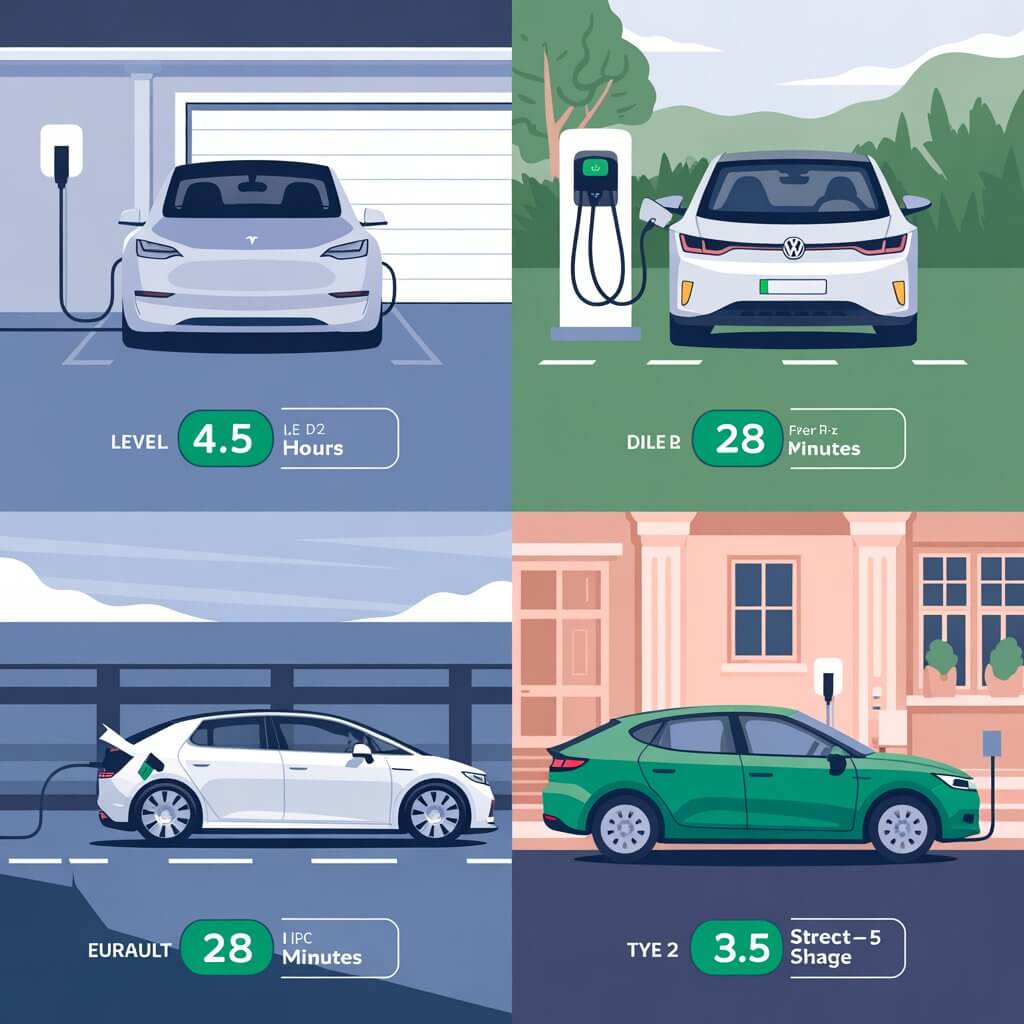
Charger Speed Calculator: How Long to Charge Your Specific EV in India (2026 Guide)

Wondering “how long does it take to charge a Tata Nexon EV with a 7kW home charger in Bengaluru” or “EV charging time for MG Windsor EV on 50kW DC fast charger India”? With India’s EV adoption soaring in 2026 — led by models like the Tata Nexon EV (45 kWh, up to 489 km range), MG Windsor EV (up to 52.9 kWh, 449 km claimed), Mahindra BE 6 (79 kWh beast), and scooters like Ola S1 Pro and Ather 450X — accurate charging time estimates eliminate guesswork and range anxiety.
Our EV charger speed calculator uses the proven formula:
Charging Time (hours) = Battery Capacity (kWh) × (Target % – Current %) / (Charger Power (kW) × Efficiency)
(Real-world efficiency: ~90% for AC home charging in Indian conditions; factor in 10-15% slowdown during 35°C+ summers common in Karnataka.)
For example:

Tata Nexon EV 45 kWh on a 7.2kW wallbox charger (popular home upgrade in Bengaluru apartments): ~6.6–7 hours for 10-100%.
MG Windsor EV on 50kW DC public charger: 20-80% in ~35 minutes (real-world tested).
Ola S1 Pro scooter (4-5 kWh): Full home charge in 5-6 hours with standard 3.3 kW.

Whether you’re calculating “how long to charge Mahindra BE 6 with 11kW charger India”, comparing home vs highway options, or checking costs at ₹7-9/unit tariffs, this guide delivers model-specific 2026 specs, easy math, and Bengaluru-focused tips (voltage fluctuations, best networks like Tata Power or Ather Grid).
Scroll down for our step-by-step calculator walkthrough, updated charging examples, cost comparisons, and top home charger recommendations (7kW vs 11kW smart units). Never wait unexpectedly again — charge smarter in India’s growing EV era!

User-friendly interactive charger selector tool displaying dropdown menu with popular Indian EVs – Tata Nexon EV, MG ZS EV, and Ather 450X – along with network options like Tata Power EZ Charge, Statiq, Ather Grid, and real-time cost estimates tailored for Indian users
EV charging

Interactive Charger Selector Tool Launch: Find the Perfect EV Charger in India in 2026

Here’s a concise, engaging excerpt (around 250-300 words) you can use as the opening or a highlighted section in your full article. It’s optimized for SEO with natural inclusion of long-tail keywords, hooks the reader immediately, and flows into encouraging tool usage.
Interactive Charger Selector Tool Launch: Your Smart Guide to Choosing the Best EV Charger in India 2026
In March 2026, India’s electric vehicle revolution is accelerating faster than ever. With public charging stations surpassing 26,000+ across the country (a nearly 5x growth since FY22) and the EV charging infrastructure market projected to grow at a 27.6% CAGR through 2033, more Indian families are making the switch to electric mobility. Popular models like the Tata Nexon EV, MG Windsor EV, MG ZS EV, Mahindra BE 6, Tata Punch EV, Ather 450X, and Ola S1 Pro dominate showrooms in Bengaluru, Delhi, Mumbai, and beyond.
But here’s the reality most new EV owners face: choosing the right home or public charger remains overwhelming. Should you go for a 7.2 kW AC home charger or a faster 11 kW option? Is a Zeon, Statiq, Tata Power EZ Charge, or Ather Grid-compatible solution best for your apartment in Bengaluru with voltage fluctuations and monsoon challenges? How do state electricity tariffs in Karnataka versus Maharashtra affect your monthly charging costs?
That’s exactly why we’ve launched our brand-new Interactive EV Charger Selector Tool India — a free, mobile-friendly tool built specifically for Indian EV drivers in 2026.
In just 30 seconds, select your exact vehicle (Tata Nexon EV, MG ZS EV, Ather Rizta, etc.), enter your daily commute distance, home parking setup (independent house or apartment society), budget range (₹15,000–₹1,50,000+), and preferred charging speed. Get instant personalised recommendations with:

Side-by-side comparisons of top brands
Real-time pricing + installation estimates in your city
Total 3-year cost of ownership (including electricity at Bengaluru rates)
Compatibility check for CCS2/GB/T ports and FAME norms

Stop guessing and start charging smarter. Whether you’re hunting for the best home EV charger under ₹25,000 in India or a reliable fast DC charger near highways, our tool delivers tailored results to save you time, money, and future headaches.
Ready to find your perfect match? Launch the Interactive Charger Selector Tool Now and drive into India’s electric future with confidence!

Rooftop solar-powered home EV charging in India: Modern white EV wall charger connected to a Tata Nexon EV in a Bengaluru home driveway, with solar panels visible on the tiled roof, illustrating reduced payback period and sustainable EV charging with solar integration 2026
EV charging

ROI Calculator: How Long Until Your Home Charger Pays for Itself in India? (2026 Updated Guide)

Thinking about installing a home EV charger in Bengaluru and wondering “how long until my home EV charger pays for itself in 2026”? With Bengaluru’s traffic-heavy commutes and BESCOM domestic electricity rates averaging ₹6.50–₹7.74 per kWh (post-2026 tariff updates), home charging delivers massive savings compared to public stations charging ₹16–₹22 per kWh.
For a typical Tata Nexon EV owner driving 50 km daily (real-world efficiency ~7.8 km/kWh), you consume about 6.4–7 kWh per day. At home rates, that’s roughly ₹42–₹55 daily versus ₹100–₹150 at public AC/DC chargers. That means daily savings of ₹50–₹100+, translating to ₹18,000–₹36,000 annually — enough to recover a ₹50,000–₹70,000 smart 7.4 kW wallbox installation (including wiring and MCB) in just 2–3.5 years.
In Bengaluru specifically, many apartment societies now approve RWA-shared home EV chargers, and off-peak/ToD tariffs can drop night rates even lower, shortening your EV home charging station payback period 2026 further. Add rooftop solar integration, and payback drops below 2 years in sunny Karnataka.
This free ROI calculator for home EV charger India 2026 breaks it down step-by-step with Bengaluru-specific numbers, popular models like Tata Power EZ Charge or Bolt.Earth, and real examples for Tata Nexon EV, MG ZS EV, and more. Discover why home charging ROI in Bengaluru 2026 makes financial sense for daily commuters — and how to choose the best home EV charger for fastest payback in India.
Read on for the full calculator formula, city-wise scenarios, top charger comparison table, and tips to slash your payback time dramatically.

Row of modern smart EV chargers along a Bengaluru street at golden hour, displaying TOU tariff rates: ₹8.50/kWh off-peak and ₹12.50/kWh peak, solar-powered stations with app interfaces, time-of-use optimization for EV charging in India 2026, urban Karnataka setting
EV charging

Time-of-Use Optimization for EV Charging in India: How Smart Chargers Save You Money in 2026

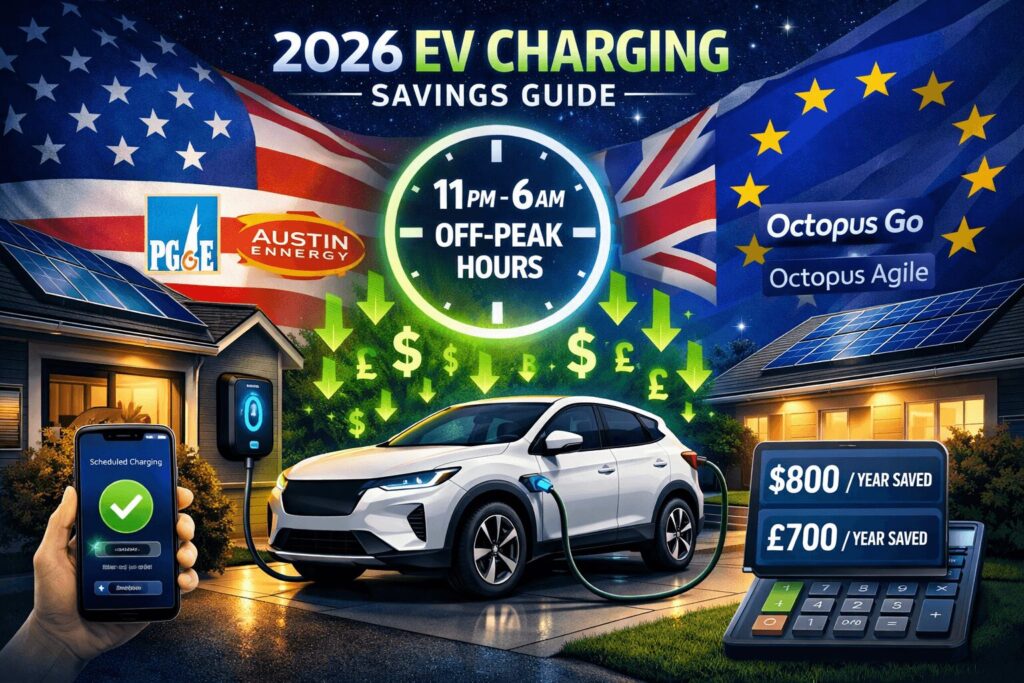
As electric vehicle adoption accelerates across India—with Bengaluru leading in urban EV growth—smart charging strategies are becoming essential for keeping costs low. Time-of-use optimization for EV charging in India leverages Time-of-Use (TOU) tariffs, where electricity rates vary by time of day: cheaper during off-peak (often nighttime) or solar-rich hours, and higher during evening peaks.
In Karnataka (including Bengaluru), BESCOM’s 2025–2028 tariff orders maintain dedicated EV charging rates at around ₹4.50/kWh base energy charges for public and depot stations, with optional TOU mechanisms offering rebates up to 100 paise/unit during low-demand periods (e.g., 10 PM–6 AM) and surcharges during peaks. Nationwide, many states now mandate TOU for EV infrastructure, with off-peak rates dropping 20–30% below average, especially when aligned with abundant solar generation during daytime hours.
Smart EV chargers with time-of-use optimization in India take the guesswork out of savings. These Wi-Fi-enabled devices automatically schedule charging during the cheapest windows—plug in anytime, set your departure time via app, and let the charger handle the rest. Features like app-based TOU integration, load balancing, and solar-hour prioritization can slash home charging costs by 30–60%, turning a full 40–60 kWh session from ₹800+ (peak/public rates) to as low as ₹200–400 overnight.
For Bengaluru residents on domestic tariffs (often ₹5.74–7.74/kWh depending on slab), combining a smart Level 2 charger (e.g., from Tata Power EZ Charge, Statiq, Bolt.Earth, or Exicom) with off-peak scheduling delivers annual savings of ₹10,000–20,000+ for daily commuters. Add rooftop solar compatibility, and midday charging becomes near-zero cost in renewable-friendly states.
Ready to cut your EV running costs? Explore the best smart EV chargers for TOU tariffs in India 2026 on our comparison tool—compare features, prices, and real-user savings tailored for Karnataka homes, apartments, and fleets. Drive smarter, charge cheaper!
This excerpt hooks readers, incorporates targeted long-tail keywords naturally, and drives traffic to the full article or comparison pages. Feel free to tweak for your site’s voice!

MG ZS EV connected to high-efficiency DC fast charger on Indian expressway with minimal electricity waste signage, best for quick low-loss charging
EV charging

Energy Efficiency Comparison: Which EV Chargers Waste the Least Electricity in India? (2026 Guide)

As electric vehicle ownership surges in India—especially in tech hubs like Bengaluru, Karnataka—EV owners are increasingly focused on one critical factor: minimizing electricity waste during charging. With rising electricity tariffs (often ₹7-10 per unit in Karnataka under BESCOM) and government schemes like PM E-DRIVE pushing greener mobility, choosing the most energy-efficient EV charger can save hundreds of rupees monthly and reduce your carbon footprint.
But which chargers truly waste the least electricity? In this 2026 energy efficiency comparison of EV chargers in India, we break down AC vs DC charger efficiency losses, real-world waste percentages, and top recommendations for home and public use.
Key insights from recent data:

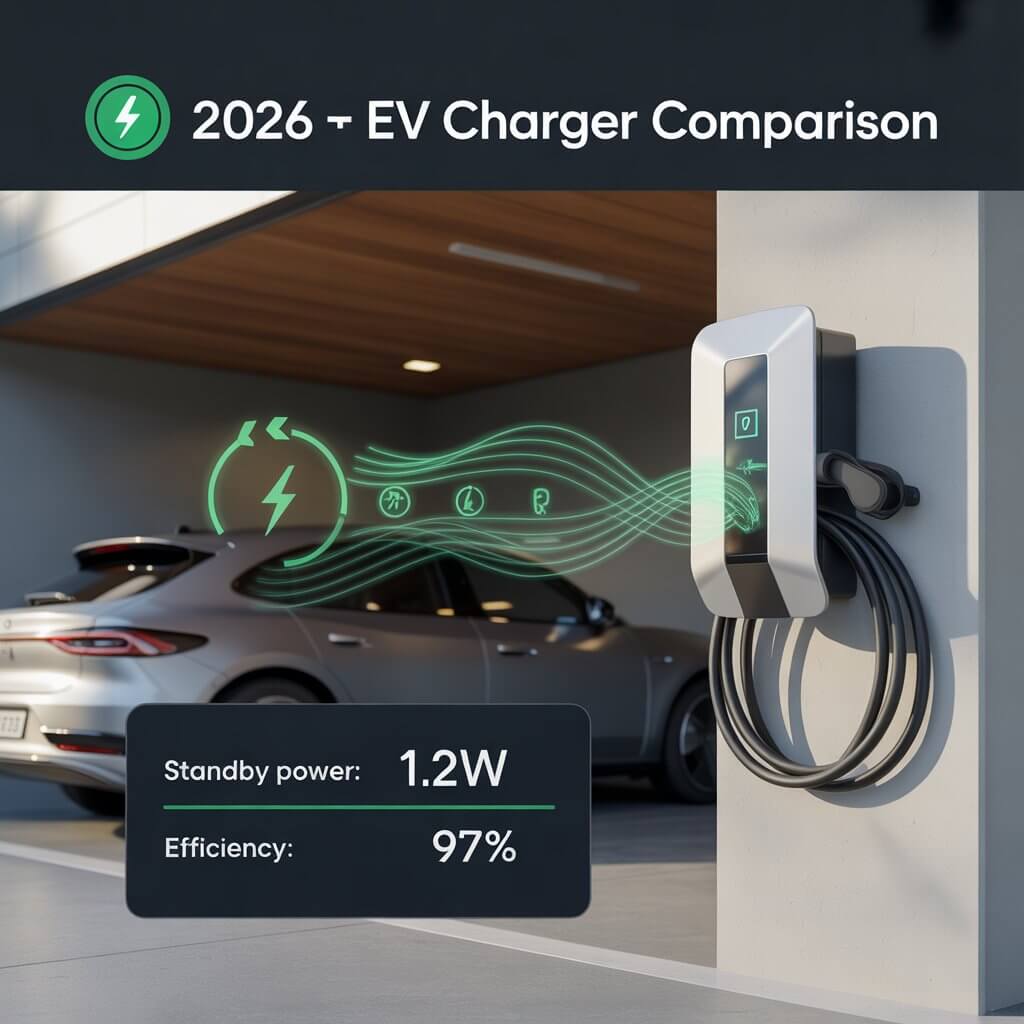
Home AC chargers (3.3kW–22kW) typically achieve 85-95% efficiency, with losses of 5-15% mainly from onboard AC-to-DC conversion. Slow overnight charging often sees the lowest waste (around 5-10%) when paired with off-peak ToD tariffs or rooftop solar—ideal for daily commuters in Bengaluru driving Tata Nexon EV, MG Comet, or Ather 450X.
DC fast chargers (50kW+) deliver 90-97% efficiency by bypassing the vehicle’s onboard converter, wasting just 3-10% overall. However, higher heat and auxiliary losses can push real-world figures to 10-15% during peak sessions.

For most Indian households, smart AC home chargers with solar integration offer the best balance of low waste, affordability, and battery health. Popular efficient picks include Victron EV Charging Station (up to 95% efficiency with solar priority) and Tata Power EZ Charge models optimized for Karnataka’s grid.
Whether you’re searching for the best energy-efficient home EV charger in Bengaluru 2026, tips to reduce EV charging electricity waste in India, or a full AC vs DC efficiency comparison for minimal power loss, read on to discover which option wastes the least—and how to slash your charging costs today.

Scroll to Top