The headline number is easy to absorb. The International Energy Agency projects that global electric car sales will reach 23 million units in 2026, accounting for 28% of all new cars sold worldwide. If the forecast holds, it will mark another record year for electric mobility and push the global EV fleet further into the mainstream.
But the headline hides a more complicated reality. The 2026 global EV sales forecast of 23 million units and 28% of global car sales is not a story of uniform growth. It is a story of markets moving in opposite directions, of policy decisions producing immediate and measurable consequences, and of an energy crisis that has reshaped the economics of driving in ways that few analysts anticipated at the start of the decade.
This is what the forecast actually reveals.
The Baseline: How We Got to 23 Million
The 2026 projection rests on a strong 2025. Global electric car sales surpassed 20 million units for the first time last year, growing 20% and reaching 25% of all new car sales. That represented the fifth consecutive year in which annual electric car sales increased by roughly 3.5 million units, a growth pattern that began in 2021 and has proven remarkably consistent.
The IEA’s Global EV Outlook 2026, published on May 20, carries the subtitle “Growing Sales Amid an Energy Crisis”. That framing is deliberate. The report was released as oil prices surged above $100 per barrel following disruption in the Middle East, and the agency’s analysts identified the energy crisis as a factor reinforcing the economic case for electric vehicles.
Fatih Birol, the IEA’s Executive Director, put it plainly: “Electric car sales set new records in close to 100 countries last year. The growing popularity of EVs has marked a major shift for car markets and the energy system as a whole, and it is providing some relief now amid the largest oil supply shock in history”.
The 23 million forecast for 2026 therefore represents a 15% increase over 2025, a slower rate of growth than the 20% recorded last year but still substantial in absolute terms.
The Divergence: Three Markets, Three Different Trajectories
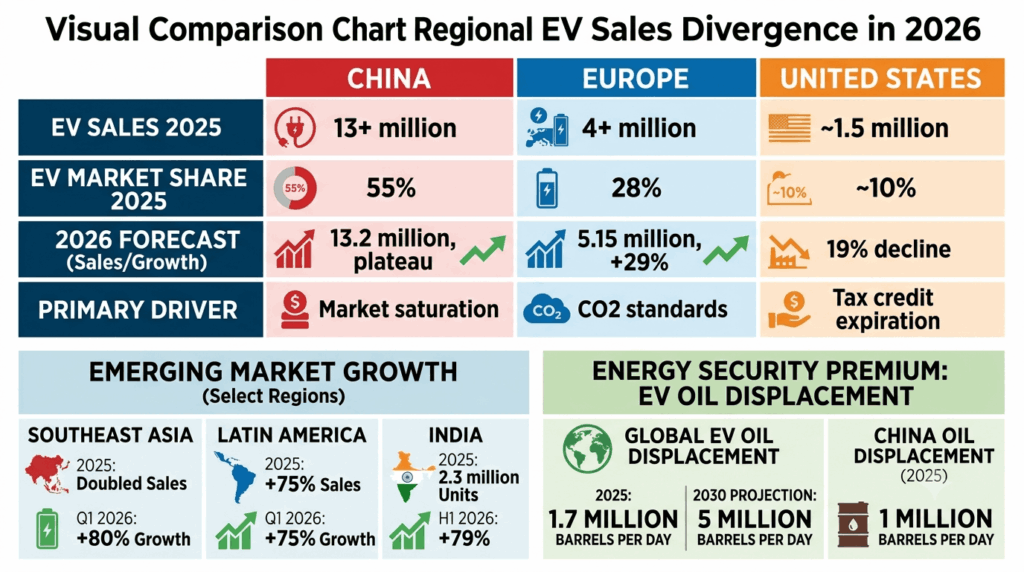
What makes 2026 distinctive is not the global total but the divergence beneath it. The gap between the world’s three largest EV markets reached its widest recorded level in the first quarter of 2026. China stood above 55% penetration, Europe at 28% and rising, and the United States at roughly 10% and falling. That 45 percentage point spread is unprecedented.
China: Approaching Saturation in New Sales
China remains the engine of the global market. The country accounted for more than 13 million electric car sales in 2025, or roughly six out of every ten electric cars sold worldwide. By the second quarter of 2026, electric cars represented more than 60% of total car sales in China, up from less than 55% across 2025.
The IEA expects Chinese electric car sales to reach approximately 13.2 million units in 2026, broadly similar to 2025 levels. Growth has plateaued in absolute volume terms because the market is approaching saturation in new sales. When six out of ten new cars are already electric, the scope for rapid further expansion narrows.
The dynamic in China is no longer about whether electric vehicles will dominate. It is about how the remaining petrol and diesel market responds. Pure petrol car sales in China crashed 42% year on year in June 2026, while the overall car market shrank 23%. The transition in China has moved from growth story to structural replacement.
Europe: Regulatory Momentum Meets Energy Economics
Europe delivered the strongest growth among major markets in 2025, with electric car sales rising more than 30% and reaching 28% of total sales. The primary driver was the step change in EU CO2 standards, which forced manufacturers to accelerate EV production and offer more competitive pricing.
That momentum has carried into 2026. Europe posted 30% year on year growth in the first quarter, and the IEA projects that EV and plug-in hybrid sales will rise about 20% in 2026, accounting for one in three cars sold. Some analysts are more bullish. A CITIC Securities research note projects European EV sales of 5.15 million units in 2026, a 29% increase, supported by the reintroduction of subsidies in Germany and Sweden and Spain’s new Auto+ programme replacing the MOVES III scheme.
The energy crisis has amplified the economic case for EVs in Europe. Based on average oil prices in April 2026, the annual fuel cost savings associated with driving an EV in the European Union grew 35% compared to 2025 savings. For corporate fleets covering long distances, the savings can be several times larger.
United States: A Policy-Driven Contraction
The United States stands apart. The expiration of the $7,500 federal EV tax credit on September 30, 2025, triggered a collapse in new EV sales that has continued into 2026. New EV sales dropped 28% year over year in the first quarter to just 212,600 units, and the second quarter brought no relief. Americans bought 247,226 new battery electric vehicles in Q2 2026, a 20.5% decline from the same quarter a year earlier. EV market share fell to 5.8%.
The IEA projects a 19% decline in US EV sales for 2026. Morgan Stanley has warned of an “EV winter,” forecasting a roughly 20% sales decline and a drop in EV penetration to 6.5%.
The US decline is not a technology problem. It is a policy outcome. The removal of federal support exposed the degree to which the market had been dependent on purchase incentives. Stephanie Valdez Streaty, director of industry insights at Cox Automotive, described the situation bluntly: “2026 will be hard. The industry is trying to find that natural demand”.
The Emerging Market Surge: The Story Beneath the Story
While the US contracts and China plateaus, the most dynamic growth in 2026 is occurring in markets that received relatively little attention in the early years of the EV transition.
In the first quarter of 2026, Asia Pacific excluding China surged by 80% year on year. Latin America expanded by 75%. In March 2026, 30 countries recorded their highest ever monthly EV sales, while a further 60 markets reported annual growth.
Southeast Asia doubled its EV sales in 2025, reaching approximately 15% of new car sales. Vietnam led with nearly 40% market share, followed by Thailand at nearly one quarter and Indonesia at 15%. The first quarter of 2026 saw an 80% increase compared to the same period a year earlier, indicating that the momentum is accelerating rather than slowing.
Latin America delivered 75% growth in 2025, led by Brazil with 286,691 electrified vehicles sold and Mexico with 96,636 units. Brazil is projected to continue its upward trend with 45% growth during 2026.
These markets share a common characteristic: they are adopting electric vehicles not primarily for environmental reasons but for economic and strategic ones. Reducing oil import dependence is a priority for countries that have watched their fuel bills rise with every geopolitical disruption. The availability of affordable Chinese models has made the economics compelling. In Thailand, Chinese made electric cars represented three quarters of the market in 2025. In Indonesia, about 75% of 2025 sales were imports from China.
The Energy Security Driver: A New Purchase Motivation
The IEA’s report identifies something that has not been present in prior EV adoption cycles: energy security as the dominant purchase motivation.
According to analysis by Axis Intelligence Research, the “Energy Security Premium” on EV adoption became the dominant purchase motivation in 2026 for the first time, surpassing both environmental concern and total cost of ownership. The Iran war driven oil price spike accelerated EV interest across Europe and Asia Pacific in the second quarter of 2026 in a pattern that has no precedent in prior IEA adoption data.
The numbers support the thesis. The global EV fleet avoided the consumption of approximately 1.7 million barrels of oil per day in 2025, up from 0.4 million barrels per day in 2020. The IEA projects that this figure could grow nearly threefold by 2030, reaching approximately 5 million barrels per day.
For China, the world’s largest oil importer, the strategic dimension is particularly acute. Electric vehicles in China alone displaced approximately 1 million barrels per day of oil demand in 2025, a figure projected to reach 2.7 million barrels per day by 2030.
The historical parallel is instructive. The oil crisis of the 1970s prompted the introduction of fuel efficiency standards that resulted in close to a doubling of the fuel economy of conventional cars over the following five decades. The IEA suggests that the current energy crisis may similarly prompt more countries to introduce or strengthen EV support policies. Vietnam has already announced plans to expand or extend its EV tax incentives as part of its response.
The Supply Chain Reality: China’s Grip Tightens
The 2026 forecast cannot be understood without acknowledging the supply chain dynamics that underpin it. China’s dominance of EV manufacturing and battery production has become more pronounced, not less.
Chinese manufacturers delivered 60% of global EV sales in 2025, while European and North American automakers each held around 15%. On the battery side, seven Chinese manufacturers now control 72.4% of global supply, up 1.5 percentage points year on year.
Almost 22 million electric cars were produced globally in 2025, a year on year increase of more than 25%. Chinese exports doubled to more than 2.5 million vehicles, cementing the country’s position as the leading EV production hub. China also accounted for more than 80% of global battery cell production.
The supply chain concentration creates both opportunity and vulnerability. For consumers in emerging markets, Chinese manufacturing has made electric vehicles affordable at price points that Western manufacturers have struggled to match. For governments concerned about industrial sovereignty and supply chain resilience, the dependence on Chinese batteries and components represents a strategic risk that the United States and Europe are attempting to address through subsidies and localisation requirements, with results that remain uncertain.
What the 23 Million Forecast Actually Means
The 23 million figure is a projection, not a guarantee. It assumes that the divergence between regions continues along its current trajectory. It assumes that European regulatory momentum is maintained, that Chinese demand stabilises at current levels, and that the US decline is contained at around 20%.
Several factors could alter the forecast. A resolution to the Middle East conflict and a sustained fall in oil prices would reduce the energy security premium that is currently driving adoption. A faster than expected recovery in US EV demand, should policy support return, would push the global total higher. A sharper than expected slowdown in China, where the overall car market contracted 23% in June, could pull the global figure down.
The IEA’s 28% market share projection is also worth contextualising. It means that slightly more than one in four new cars sold globally in 2026 will be electric. That is a remarkable figure by any historical standard. It is also a figure that masks enormous regional variation. In Norway, 97.6% of new cars sold in December 2025 were electric. In the United States, the figure is below 6%. The global average is a statistical artifact that describes no single market accurately.
What the forecast does reveal is that the EV transition has passed the point of no return in the markets that matter most for volume. China and Europe together account for the overwhelming majority of global EV sales, and both are moving decisively toward electric mobility. The United States has chosen a different path. The emerging markets are writing their own story.
The 23 million forecast is not a prediction that every market will follow the same trajectory. It is a prediction that the global total will continue to rise even as the composition of that total shifts. The question for the rest of the decade is not whether electric vehicles will dominate global car sales. It is which markets will lead, which will follow, and which will be left behind.