The European automotive landscape is undergoing a structural realignment. What was once a market dominated by Volkswagen, Stellantis, and Renault is now being reshaped by a wave of Chinese manufacturers that have moved from marginal players to significant contenders in less than five years.
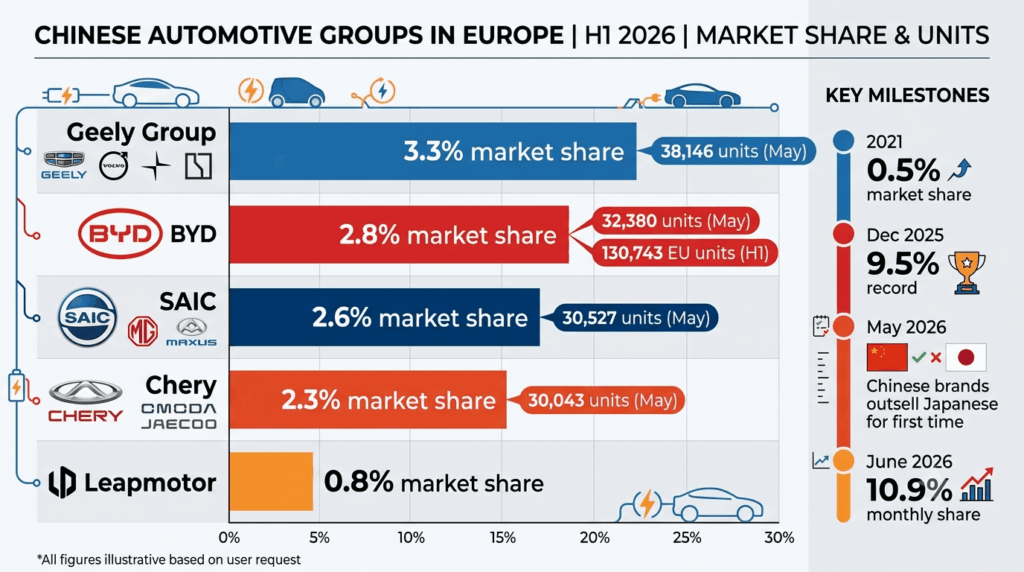
The data is stark. In the first half of 2026, Chinese automakers captured 9.5% of Europe’s new-car market, up from just 5.0% a year earlier. In June alone, their market share reached 10.9%. In May 2026, Chinese brands outsold Japanese brands in Europe for the first time, a milestone that would have seemed implausible just three years ago.
This guide on Chinese EV brands charge into Europe – BYD and Geely gain ground provides the complete, honest analysis. It covers the combined 9% European market share held by four major Chinese OEMs, the performance of BYD and Geely, the strategies driving their success, the tariffs and barriers they face, and what this means for European consumers and the automotive industry.
The Combined 9% Market Share: Four Chinese OEMs Reshaping Europe
Understanding the Numbers
The headline figure of 9% represents the combined market share of four major Chinese automotive groups: BYD, Geely, SAIC (through its MG brand), and Chery. Together, these four manufacturers have rapidly expanded their presence across the European Union, the United Kingdom, and the European Free Trade Association countries.
According to data from Schmidt Automotive Research, Chinese brands reached approximately 9% of European car sales in March 2026, including around 14% of electric vehicle sales. By the first half of 2026, this had risen to 9.5% of the overall market.
The growth is not uniform across the continent. In the G5 countries (Germany, Spain, France, Italy, and the United Kingdom), Chinese brands now account for 9.5% of passenger car registrations in early 2026, compared with 6.3% in 2025. The United Kingdom leads with 14.9% of registrations, followed by Spain at 14.2% and Italy at 13.5%. France and Germany remain at lower levels but are expected to see increased penetration as model availability expands.
This represents a remarkable transformation. In 2021, Chinese brands held just 0.5% of the European market. Five years later, that figure has grown nearly twenty-fold. The speed of this expansion has prompted analysts to significantly revise their forecasts. JPMorgan has raised its projection for Chinese OEMs’ market share in Western Europe to 20% by 2028, up from a previous estimate of 10-15% by 2030.
BYD: The Leader of the Charge
From Unknown to Europe’s Bestselling Chinese Brand
BYD has emerged as the most prominent Chinese manufacturer in Europe. In May 2026, the company sold 32,380 vehicles across the continent, a 136.6% increase year-on-year. This performance allowed BYD to overtake SAIC Motor to become Europe’s bestselling Chinese car brand, with a 2.8% market share compared with SAIC’s 2.6%.
The company’s growth trajectory is striking. In the first half of 2026, BYD registered 130,743 units in the EU alone, a 168.2% increase. Across the EU, EFTA, and the UK, the figure reached 160,717 units, representing a 2.5% market share.
BYD’s success in Europe has been built on a combination of competitive pricing and a comprehensive product lineup. The company’s Dolphin model, for example, was available in Germany at a promotional price of €15,940, less than half the price of the Renault 5 E-Tech at €28,000. The Seal U DM-i plug-in hybrid has also performed strongly, capitalising on European consumer interest in PHEVs.
A significant development came in April 2026 when BYD launched two luxury models in Europe under its Denza brand. The company also aims to build 3,000 “flash-charging” stations across the region by March 2027. This infrastructure investment signals a long-term commitment to the European market beyond simply exporting vehicles.
However, BYD’s European operations remain almost entirely dependent on imports. Every one of the 130,743 EU registrations in the first half of 2026 was an import. Assembly at the company’s Szeged plant in Hungary was delayed to Q4 2026, roughly a year later than earlier guidance, and work at its Turkish site has been paused.
Geely: The Quiet Giant
Building Through European Brands
While BYD has captured headlines with its aggressive expansion, Geely has taken a different approach. The group has built its European presence through a portfolio of established brands, including Volvo, Polestar, Lotus, Zeekr, Lynk & Co, and Smart.
This strategy has made Geely the leading Chinese group in Europe by market share in several months. In May 2026, Geely Group recorded a 3.3% market share, ahead of BYD, SAIC, and Chery. The group registered 38,146 vehicles in that month, a 12.6% increase.
A substantial portion of Geely’s European volume comes from Volvo, a Swedish brand that operates with considerable autonomy and enjoys strong consumer recognition. This has allowed Geely to establish a presence in Europe without relying solely on Chinese-branded products.
The company is also investing in local production. In July 2026, Geely announced plans to acquire a 34% stake in a Ford plant in Spain for €221 million to accelerate its localisation strategy. The joint venture with Ford is expected to produce two electric SUVs under the Geely brand from 2028.
Geely’s namesake brand has also begun to establish itself independently. In July 2026, the Geely brand recorded 4,508 sales, compared with just 168 in July 2025. The company has entered seven European markets in just 45 days, including Germany, Spain, the Netherlands, and France, and its EX5 and EX5 EM-i models are now available in more than 20 European countries.
The Other Players: SAIC and Chery
SAIC and the MG Legacy
SAIC Motor, which owns the historic British brand MG, has been a consistent presence in the European market. In the first half of 2026, SAIC registered 127,585 units in the EU, a 19.1% increase. The MG brand carries the highest EU duty rate at 35.3%, yet has maintained a market share of approximately 2.5%.
The company’s growth has converged with the broader market, with a 19.1% increase compared to 109.8% for the category as a whole. SAIC is also investing in European production, with plans to build its first EU assembly plant in Galicia, Spain, with an initial investment of approximately €200 million.
Chery: The Fastest Riser
Chery Automobile has recorded the most dramatic growth among the major Chinese manufacturers. In the first half of 2026, the company registered 84,987 units in the EU, a 268.7% increase. Its growth has been driven primarily by the Omoda and Jaecoo brands rather than the Chery nameplate.
Chery’s Ebro joint-venture plant in Barcelona, which occupies a former Nissan factory, has faced repeated delays in starting production. However, the company has ambitious plans, targeting annual production of 50,000 units by 2027 and 150,000 by 2029.
Why Chinese Brands Are Winning
Price, Technology, and Electrification
The success of Chinese brands in Europe is not attributable to a single factor. Several elements have converged to create a compelling proposition for European consumers.
Price competitiveness. Chinese manufacturers have been able to offer vehicles with equivalent or superior specifications at lower prices than established European brands. The BYD Dolphin’s promotional price of €15,940 in Germany, compared with €28,000 for the Renault 5 E-Tech, illustrates the magnitude of the price advantage. The Leapmotor T03, distributed through Stellantis, is priced under €17,000, compared with nearly €19,500 for the Renault Twingo E-Tech.
Electrification focus. Chinese manufacturers have concentrated their European efforts on electric and plug-in hybrid vehicles, precisely the segments where European brands have been slower to achieve cost parity. In June 2026, Chinese brands captured 15% of the battery electric vehicle market and 34% of the plug-in hybrid market.
Product strategy. The Chinese approach has been to target the volume segments where European manufacturers generate the bulk of their sales. As the French business magazine L’Usine Nouvelle noted, Chinese brands are “installing themselves precisely where Renault and Stellantis achieve the bulk of their volumes, the electric city car under €20,000 and the compact small SUV”.
Vertical integration. Companies such as BYD operate with a high degree of vertical integration, controlling the supply chain from battery production to final assembly. This “mine to wheel” strategy provides significant cost advantages over competitors who rely on external suppliers.
The Barriers: Tariffs, Profitability, and Localisation
The EU Tariff Response
The European Union responded to the surge in Chinese EV imports by imposing countervailing duties in October 2024. These duties, which remain in force for five years, apply on top of the standard 10% import tariff.
The rates vary by manufacturer:
- Tesla (individual examination): 7.8% countervailing duty, 17.8% total
- BYD: 17.0% countervailing duty, 27.0% total
- Geely: 18.8% countervailing duty, 28.8% total
- SAIC: 35.3% countervailing duty, 45.3% total
However, the measures are narrower than they might appear. They cover new battery electric vehicles designed for the transport of persons. Full hybrids and plug-in hybrids built in China sit outside them entirely. This has allowed Chinese manufacturers to continue growing in Europe by focusing on PHEV models.
The EU has also published guidance on price undertaking offers, allowing exporters to replace duties with a minimum import price, volume cap, and EU investment commitments. As of mid-2026, no Chinese-owned producer had an accepted undertaking.
Profitability Challenges
While Chinese brands have captured market share, profitability remains elusive. A detailed analysis by China Biz Insider examined the economics of exporting Chinese EVs to Europe.
For a vehicle with a European retail price of €38,000, the pre-tax revenue available to the manufacturer is approximately €31,900 after VAT. Manufacturing and logistics costs consume €18,000 to €22,000 per vehicle. EU tariffs add a further 17.4% for BYD, 18.8% for Geely, and 35.3% for SAIC. Dealer margins absorb 8-15% of the retail price. After all deductions, the per-unit contribution margin is typically under €3,000.
This thin margin structure means that the export model generates market presence more reliably than profit. The logical response is local manufacturing, which eliminates countervailing duties. However, local production brings its own challenges. BYD’s Hungarian plant represents an investment of approximately €4 billion and needs to reach annual sales of 120,000 to 150,000 units before local production becomes cost-competitive with imports.
The Localisation Question
European industry groups have questioned the depth of Chinese manufacturers’ commitment to local supply chains. Roberto Vavassori, president of the Italian automotive suppliers’ association Anfia, has called for 80% tariffs on Chinese vehicles and components above an 8% market share threshold. He has described Chinese factories in Europe as “screwdriver factories,” predicting that manufacturers will continue importing most components from China.
The reality is more nuanced. Companies such as BYD and Chery are making substantial investments in European production capacity. Whether these investments translate into meaningful local supply chain development will depend on a range of factors, including labour costs, supplier availability, and the regulatory environment.
What This Means for European Consumers and the Auto Industry
For Consumers
The entry of Chinese brands has expanded consumer choice and intensified price competition. European buyers now have access to a wider range of electric and plug-in hybrid vehicles at more accessible price points. The presence of Chinese competitors has also pressured established brands to improve their value proposition.
However, consumers should consider factors beyond purchase price. The residual value of Chinese brands in Europe remains uncertain, as does the long-term availability of spare parts and service networks. The European aftermarket is still adapting to the new generation of vehicles built around different industrial models and electrified architectures.
For the European Auto Industry
The rise of Chinese brands represents both a competitive threat and an opportunity. For established manufacturers, the pressure is intense. Stellantis has been the biggest loser, with its market share falling from 21.7% in 2021 to 15.3% in 2026, a decline of 6.4 percentage points corresponding to approximately 310,000 lost sales.
Some European manufacturers are responding by partnering with Chinese companies. Stellantis has established a joint venture with Leapmotor to produce vehicles in Spain. Ford has entered a joint venture with Geely for its Valencia plant. Volkswagen has partnered with Xpeng. These collaborations represent a recognition that the competitive landscape has fundamentally changed.
The Road Ahead
The trajectory of Chinese brands in Europe will depend on several factors. The pace of localisation will determine whether they can avoid tariffs and reduce costs. The evolution of EU trade policy will shape market access. Consumer acceptance of Chinese brands will influence long-term brand equity.
Analysts are divided on how far Chinese brands can go. Some suggest a ceiling of 20% market share. Others, including the former head of Volkswagen UK, believe Chinese brands could ultimately capture 30% of European sales. What is clear is that the European automotive market is undergoing a structural transformation that will reshape the competitive landscape for years to come.
The honest verdict: Chinese EV brands have moved from the periphery to the centre of the European automotive market. The combined 9% market share held by BYD, Geely, SAIC, and Chery represents a fundamental shift in competitive dynamics. The era of European dominance in its own market is over. The question is no longer whether Chinese brands will succeed in Europe, but how far they will go.