The European Union has moved to correct a regulatory anomaly that has been quietly penalising electric vans for their own battery weight. On December 16, 2025, the European Commission presented a proposal to amend Directive 92/6/EEC to exempt certain N2 category electric vehicles from the requirement to install and use a speed limitation device. The exemption applies to battery-electric vans with a maximum technically permissible laden mass between 3.5 and 4.25 tonnes.
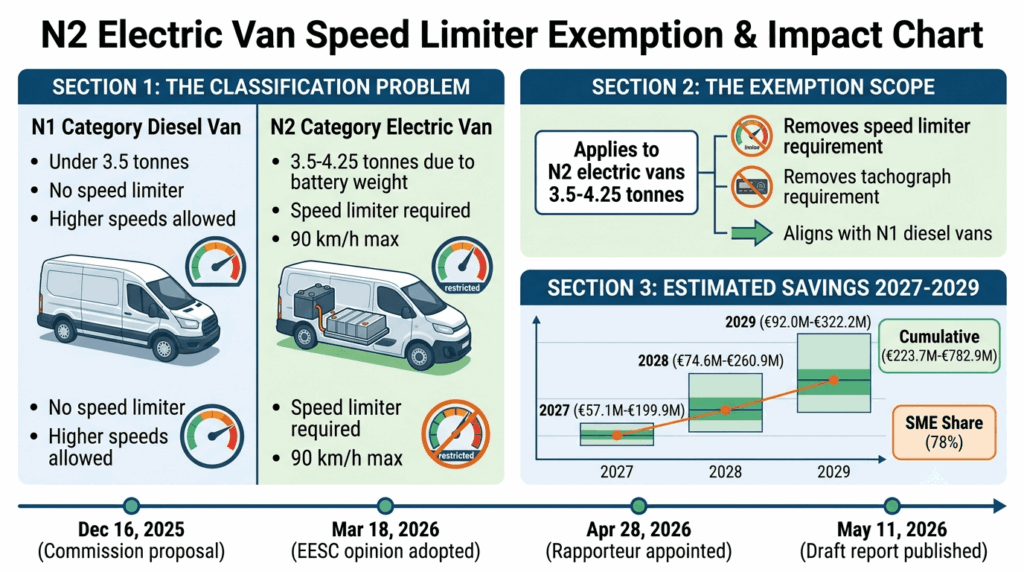
The rationale is straightforward. Electric light commercial vehicles are heavier than their internal combustion engine counterparts due to the weight of their batteries. As a result of this additional weight, they fall into category N2 and are subject to legislation requiring speed limitation devices, unlike light commercial vehicles with internal combustion engines that remain in category N1. This regulatory burden makes e-vans less attractive to customers, many of whom are small and medium-sized enterprises and micro-enterprises.
This guide on new EU van rules: N2 category EVs exempt from speed limiter mandates provides the complete, honest analysis. It covers the specific technical provisions, the regulatory rationale, the estimated cost savings, the legislative process, the road safety concerns, and what this means for Europe’s electric van market.
The Regulatory Anomaly: How Battery Weight Triggered a Heavy-Duty Rule
The Weight Problem That Classified E-Vans as Trucks
Directive 92/6/EEC requires the installation and use of speed limitation devices in certain heavy-duty vehicles for road safety reasons. Under Article 3(1) of the Directive, vehicles in categories N2 and N3 may only be used on the road if equipped with a speed limitation device that prevents them from exceeding 90 kilometres per hour.
The problem is that category N2 covers goods vehicles with a maximum mass exceeding 3.5 tonnes but not exceeding 12 tonnes. When an electric van’s battery pushes its gross vehicle weight above 3.5 tonnes, it automatically enters N2 territory. A diesel van with essentially the same payload and use case remains in N1 and faces no speed limiter requirement.
The practical consequence is significant. As the Commission’s impact assessment noted: “The inclusion of such a device in these e-Vans thus means that diesel vans can drive at higher speeds”. In other words, the cleaner vehicle is artificially constrained while the fossil fuel alternative is not.
The Exemption: What Specifically Changes
The Two Legislative Amendments
The exemption is being implemented through two parallel legislative instruments within the broader Automotive Omnibus package.
First, the amendment to Directive 92/6/EEC:
The Commission proposes adding a new paragraph in Article 3 of Directive 92/6/EEC exempting the vehicles in question from the need to be equipped with a speed limitation device to allow them to be used on the road. The amended text would read: “Member States shall take the necessary measures to ensure that motor vehicles of categories N2 and N3, except those vehicles of category N2 propelled exclusively by means of electricity and with a maximum permissible mass between 3,5 and 4,25 tonnes, may be used on the road only if equipped with a speed limitation device set in such a way that their speed cannot exceed 90 kilometres per hour”.
Second, the amendment to Regulation (EU) 2019/2144:
In Article 9 of the General Safety Regulation, the Commission proposes adding a new paragraph stating: “Vehicles of category N2 propelled by means of electricity, with maximum permissible technical laden mass between 3.5 and 4.25 tonnes, shall not be required to be equipped with speed limitation devices in accordance with UN Regulation No 89”.
The parallel tachograph exemption:
The proposal is part of a broader effort to reduce regulatory obstacles for electric vehicle uptake. Alongside the speed limiter exemption, the Commission is also removing the requirement of tachograph installation for battery-electric light commercial vehicles with a weight below 4.25 tonnes. The tachograph and speed limiter issues are directly linked: both stem from the same weight-based classification problem that affects electric vans.
The Economic Case: €782 Million in Cumulative Savings
The Cost Relief for SMEs and the Automotive Industry
The Commission’s impact assessment estimates significant savings from the exemption. The total savings of the measure lie between EUR 223.7 million (lower-bound estimate) and EUR 782.9 million (upper-bound estimate) from 2027 to 2029.
The distribution of savings:
Of these savings, 78% are attributable to SMEs and 22% to large companies. This reflects the fact that the light commercial vehicle market is dominated by small and medium-sized enterprises, particularly tradespeople and service providers who rely on vans with payloads in the 3.5 to 4.25 tonne range.
The annual breakdown:
| Year | Lower-Bound Estimate | Higher-Bound Estimate |
|---|---|---|
| 2027 | €57.1 million | €199.9 million |
| 2028 | €74.6 million | €260.9 million |
| 2029 | €92.0 million | €322.2 million |
| Cumulative | €223.7 million | €782.9 million |
Source: European Commission Impact Assessment
The total cost of ownership impact:
The Commission notes that eliminating this requirement would contribute to decreasing the total cost of ownership of these vehicles, which are used by many SMEs, in particular tradesmen, that need vans with this payload. Removing the speed limitation device also removes an adjustment cost that would likely benefit customers.
The Road Safety Debate: Balancing Simplification with Safety
The Concerns Raised by Type-Approval Authorities
The exemption has not been without opposition. Seven type-approval authorities raised concerns that removing speed-limiting devices would impact negatively on safety. Their argument is straightforward: speed limiters were introduced for heavy-duty vehicles to ensure road safety and environmental protection, and removing them from any category of vehicle could increase risk.
The Commission’s response:
The Commission argues that the level of safety of e-Vans with gross vehicle weights between 3.5 tonnes and 4.25 tonnes is expected to remain robust due to comprehensive standards, such as cab impact and electric safety tests, that ensure a high level of vehicle integrity and occupant protection.
Furthermore, the widespread deployment of advanced driver assistance systems in these vehicles today contributes to their enhanced safety performance, providing equivalency compared to their fossil-fuel counterparts with similar use-case and payload. Electric vans are often equipped with automatic emergency braking, lane-keeping assistance, and other ADAS features that are not universally present on older diesel vans.
The EESC’s position:
The European Economic and Social Committee, in its opinion on the proposal adopted on 18 March 2026, underlined that regulatory simplification should not come at the expense of established road safety standards or the protection of drivers and vulnerable road users, including cyclists and pedestrians.
However, the EESC also stressed the importance of zero-emission commercial vehicles for achieving EU climate objectives, especially in urban distribution and service delivery. The Committee called on the Commission to keep the exemption, if accepted, conditional for the time being, with conditionality linked to an evaluation after a certain period of time. The EESC adopted its opinion with 205 votes in favour, 1 against, and 3 abstentions.
The Legislative Process: Where the Proposal Stands
The Timeline and the Institutional Positions
The proposal was presented by the European Commission on 16 December 2025. In the European Parliament, the Committee on Transport and Tourism is responsible for the file. Merja Kyllönen (Finland, The Left) was appointed Rapporteur on 28 April 2026.
The rapporteur published her draft report on 11 May 2026, proposing to take over the Commission’s proposal. In total, 12 amendments to the proposal were tabled by MEPs in the TRAN committee. Discussions have also begun in the Council of the EU.
The broader Automotive Package context:
The speed limiter exemption is one element of the broader Automotive Omnibus, which the Commission describes as aiming to remove regulatory barriers that disproportionately affect electric vehicles, in particular in the light commercial and small passenger car segments. The Automotive Package was published on 16 December 2025 and includes multiple legislative proposals and non-legislative measures.
The expected implementation:
If the proposal is adopted and enters into force, the exemption would apply from the date specified in the final legislative text. The Commission’s impact assessment covers the period 2027 to 2029, suggesting that the exemption is expected to be operational by 2027.
The Electric Van Market: Growth and the Role of Regulation
The Momentum Behind Electric LCVs
The exemption comes at a time of strong growth in Europe’s electric van market. Electrically chargeable vans recorded 41.6% growth in the first half of 2026, increasing their market share from 9.5% in H1 2025 to 13.2%.
In the first quarter of 2026, electrically chargeable vans grew by 42%, capturing 12% market share, an increase from 8.7% in the first quarter of 2025. Diesel remains the dominant choice with a share of around 80%, but electric vans are gaining ground steadily.
The Kia PV5 effect:
The Kia PV5 has emerged as a significant player in the European electric van market. In the first half of 2026, the PV5 accounted for over one-third of Europe’s small electric van market, with 13,116 units sold and a 37% share of the C-segment electric van market.
The exemption’s market impact:
Removing the requirement to have speed limitation devices in e-Vans with gross vehicle weights between 3.5 and 4.25 tonnes would encourage the uptake of such zero-emission vans versus their fossil fuel counterpart, thus delivering positive environmental effects in line with the CO2 Regulation. The exemption removes a cost disadvantage that has made electric vans less competitive than their diesel equivalents.
What This Means for Europe’s Van Operators
The Practical Implications
For SME fleet operators:
The exemption directly benefits the small and medium-sized enterprises that dominate the light commercial vehicle market. Tradespeople, delivery companies, and service providers who need vans with payloads in the 3.5 to 4.25 tonne range will see lower upfront costs and reduced total cost of ownership. The speed limiter device adds cost to the vehicle without delivering any corresponding benefit, since the diesel vans these businesses could choose instead face no such requirement.
For the electric van market:
By removing a regulatory penalty that applied only to electric vans, the exemption levels the playing field between electric and diesel light commercial vehicles. This should accelerate the adoption of electric vans, which is essential for achieving the EU’s CO2 reduction targets in the transport sector. Urban distribution and service delivery, where vans are heavily used, are precisely the applications where zero-emission vehicles deliver the greatest air quality benefits.
For the broader EV transition:
The exemption is part of a wider regulatory simplification effort that includes the tachograph exemption for battery-electric light commercial vehicles and the M1E category for small affordable electric cars. These measures collectively reduce the regulatory burdens that have slowed electric vehicle adoption in segments where the transition is most challenging.
The conditional exemption question:
The EESC’s recommendation that the exemption be conditional and subject to evaluation after a certain period is worth taking seriously. If the exemption leads to measurable safety impacts, the Commission will need to revisit the decision. However, the safety case for the exemption is strong: these vehicles have the same payload and use case as N1 diesel vans, are subject to comprehensive safety standards including cab impact and electric safety tests, and are increasingly equipped with ADAS features that were not available when the speed limiter rules were originally designed.
Internal Links: Further Reading on Clean Energy Bazaar
The new EU van rules: N2 category EVs exempt from speed limiter mandates guide connects to the European EV policy and commercial vehicle guides on cleanenergybazaar.com.
For the EU Omnibus automotive proposal guide covering the broader regulatory package, our EU Omnibus automotive proposal: a new small and affordable EV category guide covers the M1E category and the full Automotive Package. For the electric heavy-duty truck sales guide covering the commercial vehicle electrification trend, our electric heavy-duty truck sales triple: the 200,000-unit logistics revolution guide covers the heavy freight segment. For the Europe’s EV sales surge guide covering the European market context, our Europe’s EV sales surge 30% – how Germany, Spain, and Italy are leading the comeback guide covers the regional EV adoption surge. For the IEA Global EV Outlook 2026 summary covering the global EV transition, our IEA Global EV Outlook 2026: 2025 sales hit 20M, capturing 25% of global car sales guide covers the flagship report in full.
Final Thoughts
New EU van rules: N2 category EVs exempt from speed limiter mandates — and the exemption represents a sensible correction to a regulatory anomaly that has been penalising electric vans for their own battery weight.
The problem was clear. Electric vans are heavier than their diesel equivalents because of their batteries. That extra weight pushes them from N1 into N2 classification, where they face speed limiter requirements that diesel vans with identical payloads and use cases do not. The result was that diesel vans could drive at higher speeds than electric vans, and electric vans carried an extra cost that made them less attractive to the SMEs that dominate the light commercial vehicle market.
The solution is proportionate. Exempting N2 electric vans with gross vehicle weights between 3.5 and 4.25 tonnes from the speed limiter requirement removes a cost disadvantage without compromising safety. These vehicles are subject to comprehensive safety standards, are increasingly equipped with ADAS features, and have the same use case as the N1 diesel vans they compete with.
The savings are substantial. The Commission estimates cumulative savings of €223.7 million to €782.9 million from 2027 to 2029, with 78% accruing to SMEs. This is real money for small businesses that need electric vans to operate.
The road safety concerns are legitimate but manageable. The EESC’s recommendation that the exemption be conditional and subject to evaluation is a sensible safeguard. If problems emerge, the Commission can revisit the decision.
The honest verdict: the N2 electric van speed limiter exemption is a targeted, proportionate, and well-evidenced regulatory change. It removes a barrier that was slowing the adoption of zero-emission commercial vehicles, benefits the SMEs that drive Europe’s economy, and supports the EU’s climate objectives. The road safety debate is worth having, but the evidence strongly supports the Commission’s position. Electric vans should not be penalised for being electric.