The federal EV tax credit landscape changed dramatically on September 30, 2025. The $7,500 federal tax credit for new EVs and the $4,000 credit for used EVs are no longer available for vehicles acquired after that date. For American EV buyers, the rules of the game have fundamentally shifted.
But that does not mean the incentives have disappeared entirely. States, utilities, and local governments have stepped into the breach. Some states have launched aggressive new programs to fill the gap left by the federal government’s withdrawal. Others have scaled back their support. And a few have never offered meaningful incentives at all.
This 2026 EV buyer’s guide: a state-by-state incentive checklist for the US provides the complete, honest breakdown of what is available in every state. It covers state rebates and tax credits, utility programs, sales tax exemptions, and other perks like HOV lane access. It also explains the federal incentives that remain available, including the charger installation credit that expires on June 30, 2026.
Whether you are a first-time EV buyer or a current owner looking to upgrade, this guide will help you understand exactly what you can get and where.
The Federal Landscape: What Is Still Available in 2026
Before diving into the states, it is essential to understand what the federal government still offers.
The federal EV purchase tax credits (30D, 25E, 45W) are gone. These credits are not available for vehicles acquired after September 30, 2025. If you did not purchase your EV before that date, you cannot claim them.
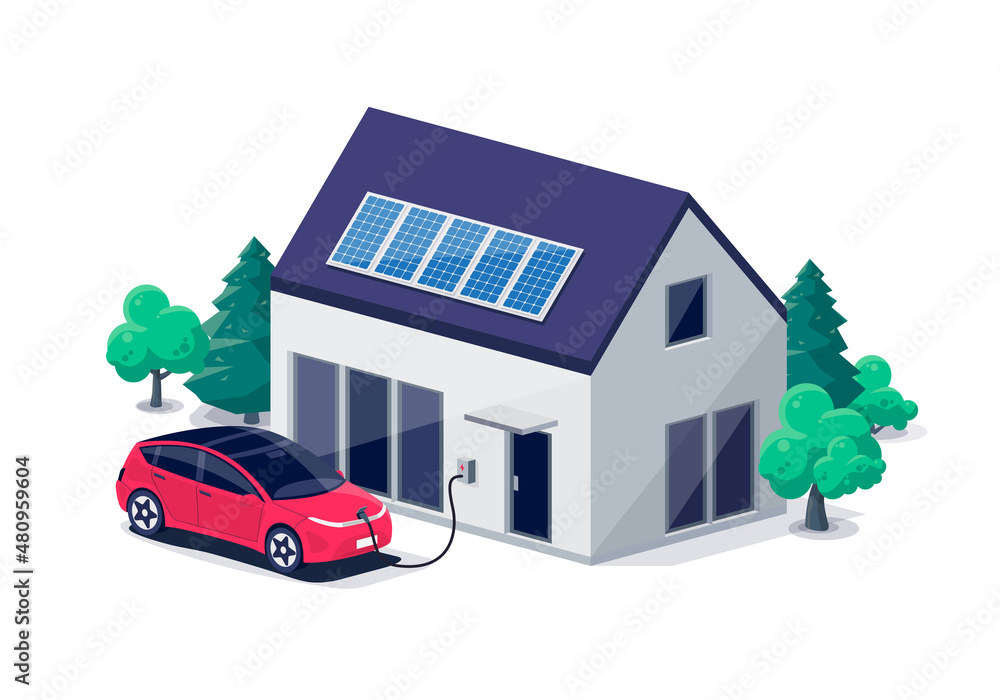
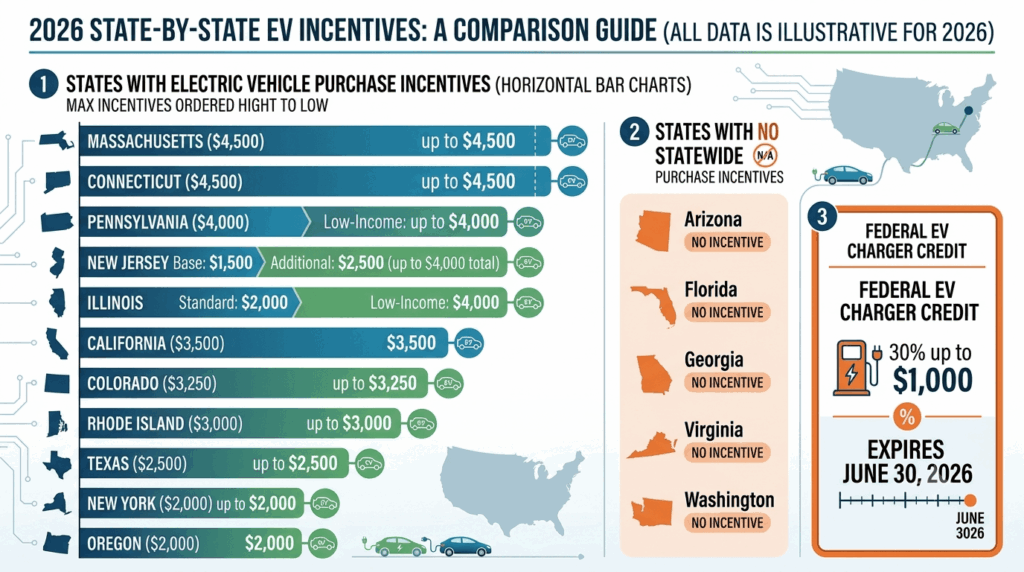
The federal EV charger tax credit (Section 30C) is still available but expiring soon. This credit covers 30% of the cost of buying and installing a home EV charger, up to $1,000. However, it is scheduled to run through June 30, 2026. If you are planning to install a home charger, you should act before this deadline.
The federal government also eliminated penalties for automakers that fail to meet fuel efficiency standards, removing a key driver of EV production incentives. This has contributed to the broader policy shift away from EV support at the federal level.
With the federal withdrawal, state and local incentives have become more important than ever. Here is what is available in each state.
State-by-State Incentive Checklist
California: $3,500 Instant Rebate for First-Time Buyers
California has responded to the federal withdrawal with one of the most aggressive state programs in the country. Governor Gavin Newsom signed SB 168 into law, creating the “MyFirstEV” program.
The program: First-time EV buyers can receive an instant $3,500 rebate when purchasing or leasing a new battery electric or fuel cell electric vehicle. Used EVs priced at $25,000 or below qualify for a $1,750 rebate. The program is funded by $135.5 million from the 2026-2027 state budget.
Eligibility: New vehicles must be model year 2026 or newer with an MSRP under $50,000. Used EVs must be priced under $25,000. The rebate is available only to first-time EV buyers.
Participating automakers: Tesla and 13 other major automakers are participating in the program.
California also offers: Access to HOV lanes for qualifying EVs, which can save significant time in congested areas.
Colorado: Up to $3,250 State Tax Credit
Colorado remains one of the most generous states for EV incentives, though the structure has changed for 2026.
The program: The base Innovative Motor Vehicle Credit drops to $750 for 2026, down from $3,500 in previous years. However, vehicles with an MSRP under $35,000 qualify for an additional $2,500 bonus credit. This creates a maximum state tax credit of $3,250 for qualifying low-cost EVs.
Eligibility: The base credit applies to any new EV or plug-in hybrid with an MSRP up to $80,000. The $2,500 bonus applies only to vehicles under $35,000 MSRP.
Important: Colorado’s EV tax credit drops significantly from previous years, but the low-cost EV bonus helps maintain meaningful savings for buyers of more affordable models.
New York: Drive Clean Rebate Up to $2,000
New York has committed an additional $30 million to its Drive Clean Rebate program in 2026.
The program: Point-of-sale rebates range from $500 to $2,000 for consumers purchasing or leasing battery electric or plug-in hybrid vehicles. Higher rebates are available for longer-range models.
Eligibility: Over 60 models qualify for the rebate. Vehicles with a range between 40 and 199 miles qualify for a $1,000 rebate. Models with shorter range or an MSRP exceeding $42,000 receive a $500 rebate.
New York also offers: Additional utility incentives through NYSERDA and access to HOV lanes for qualifying EVs.
New Jersey: Charge Up Program Up to $4,000
New Jersey relaunched its incentive programs on July 1, 2026.
The program: The standard Charge Up incentive provides $1,500 for eligible vehicles with an MSRP up to $55,000. Income-verified applicants can qualify for an additional $2,500 through Charge Up+, bringing the total to $4,000.
Eligibility: The program is open to New Jersey residents purchasing or leasing new EVs. Income requirements apply for the enhanced $4,000 incentive.
New Jersey also offers: Exemption from state sales tax on EV purchases.
Illinois: $2,000 Rebate (Up to $4,000 for Low-Income)
Illinois has reopened its EV Rebate Program for the FY2026 cycle, running from August 1 to December 31, 2026.
The program: Eligible applicants can receive a $2,000 rebate for a new or used electric vehicle. Low-income applicants may qualify for up to $4,000.
The declining structure: The rebate amount is set to decline over time. Beginning July 1, 2026, the rebate is $2,000. Beginning July 1, 2028, it will drop to $1,500.
Illinois utility incentives: ComEd has launched a $70 million EV rebate program for residential, business, and community customers across Northern Illinois in 2026.
Massachusetts: MOR-EV Program Up to $4,500
The Massachusetts Offers Rebates for Electric Vehicles (MOR-EV) Program remains one of the most established state EV incentive programs.
The program: Individuals can save $3,500 when purchasing or leasing an EV. Income-eligible residents may qualify for higher rebates up to $4,500.
Commercial incentives: Businesses and nonprofit organizations can receive rebates up to $6,000 for new and used light-duty EVs. Class 2b-3 zero-emission trucks and vans qualify for rebates up to $7,500 per vehicle.
Public comment period: The program is currently undergoing amendments, with a public comment period running from July 31 to September 4, 2026.
Oregon: Clean Vehicle Rebate Program (August 25 – November 4, 2026)
Oregon’s Clean Vehicle Rebate Program reopens for a limited window in 2026.
The program: The standard rebate provides $2,000 toward eligible new battery-electric vehicles. Plug-in hybrids qualify for $1,500. Zero-emissions motorcycles receive $375. Some sources indicate low-income applicants may qualify for up to $7,500.
Timing: Vehicles must be purchased or leased between August 25 and November 4, 2026. Rebates will be suspended as of November 5, 2026.
Important: Applicants will be placed on a waitlist if rebate funds are depleted. The program has historically been popular and funding can run out quickly.
Connecticut: CHEAPR Program Up to $4,000 (or $5,000 for Used)
Connecticut’s CHEAPR (Connecticut Hydrogen and Electric Automobile Purchase Rebate) Program offers sliding rebates based on vehicle range and income.
The program: The standard EV rebate is $1,500. Income-eligible residents can receive up to $4,500 toward a new EV. Used EV buyers may qualify for up to $5,000. Rebates range from $750 to $3,000 based on battery range.
Eligibility: The program is open to Connecticut residents purchasing or leasing eligible battery electric vehicles. Rebate+ provides an additional $3,000 on top of the standard rebate for income-qualified residents.
Rhode Island: DRIVE EV Program Up to $3,000
Rhode Island increased its DRIVE EV rebate amounts on January 5, 2026.
The program: New battery or fuel-cell EVs qualify for up to $3,000. New plug-in hybrids qualify for $2,000.
Texas: Light-Duty Motor Vehicle Purchase or Lease Incentive Program (LDPLIP) Up to $2,500
Texas offers a post-sale grant through the LDPLIP, administered by the Texas Commission on Environmental Quality.
The program: Buyers of new electric or hydrogen fuel cell vehicles can receive a rebate of up to $2,500. Applications are accepted until August 31, 2026, or until funding is exhausted.
Utility incentives: Austin Energy offers rebates of up to $1,200 for homeowners installing Level 2 EV charging stations.
Pennsylvania: Alternative Fuel Vehicle Rebate Up to $4,000
Pennsylvania’s Alternative Fuel Vehicle (AFV) Rebate program continues in 2026.
The program: New EVs qualify for a $3,000 rebate. Plug-in hybrids receive half that amount. Electric motorcycles qualify for a $500 rebate. Low-income residents may receive up to $4,000 for an EV.
Eligibility: Income-based rebates are available with upper-middle income applicants (up to 400% of the Federal Poverty Level) receiving approximately $1,000 to $1,750.
Maryland: EV Excise Tax Credit (Funding Depleted)
Maryland’s EV excise tax credit remains on the books but faces a critical challenge.
The current status: The Fiscal Year 2026 funds for the EV excise tax credit have been declared depleted. The Maryland Motor Vehicle Administration has advised that funding is no longer available for FY 2026.
What is changing: Legislation effective July 1, 2026, converts Maryland’s ZEV excise tax credit program into a point-of-sale rebate program for vehicles purchased and titled between July 1, 2026 and June 30, 2027. However, this depends on available funding in the FY 2027 budget.
The credit amount: If funded, the credit would be $3,000 for each zero-emission plug-in electric drive or fuel cell vehicle purchased.
Virginia: Used EV Rebate Only ($500)
Virginia’s EV incentive landscape is limited in 2026.
The program: A flat $500 rebate is available for eligible used electric motor vehicles purchased and registered on or after July 1, 2026. No rebates are available for new vehicles.
Eligibility: Rebates are issued on a first-come, first-served basis while funds remain available. Income-qualified residents (at or below 300% of Federal Poverty Guidelines) may be eligible.
Sales tax exemption: Virginia exempts electric vehicles from the retail sales and use tax when registered for the first time in the Commonwealth.
Washington: No Statewide Purchase Incentive
Washington does not currently offer statewide incentives, rebates, or tax credits for purchasing or leasing EVs.
Commercial incentives: The Washington Zero-Emission Incentive Program (WAZIP) helps businesses and commercial fleets save money when they buy or lease cleaner vehicles and equipment.
Utility incentives: Some local utilities offer EV charger rebates, including Columbia REA ($125 per Level 2 charger) and others.
Arizona: No Statewide Purchase Incentive
Arizona does not offer statewide incentives, rebates, or tax credits for purchasing or leasing EVs.
Sales tax exemption: Arizona does offer a sales tax exemption that lowers upfront costs for EV buyers.
Charger credit expired: The federal EV charger tax credit (30C) expired on June 30, 2026.
Florida: No Statewide Purchase Incentive
Florida does not offer a statewide EV purchase rebate or income-tax credit in 2026.
Utility incentives: Some local utilities offer EV charger rebates. Orlando Utilities Commission provides $200 to residential customers who purchase or lease an eligible new or preowned EV. JEA offers up to $850 per Level 2 charger and up to $3,000 per DC fast charger.
Georgia: No Statewide Purchase Incentive
Georgia no longer offers a tax credit for EV purchases or leases. The program was ended by the legislature in 2016.
Federal charger credit expired: The commercial charging tax credit and Alternative Fuel Vehicle Refueling Property Credit both expired on June 30, 2026.
States with No Statewide EV Purchase Incentives
The following states do not offer statewide purchase incentives, rebates, or tax credits for EVs in 2026:
- Washington
- Arizona
- Florida
- Georgia
- Virginia (new vehicle rebate only; used EV rebate available)
In these states, buyers should look for utility incentives, local programs, and the federal charger tax credit (until June 30, 2026).
Utility Incentives and Time-of-Use Rates
Beyond state programs, many utilities offer their own EV incentives. These can include:
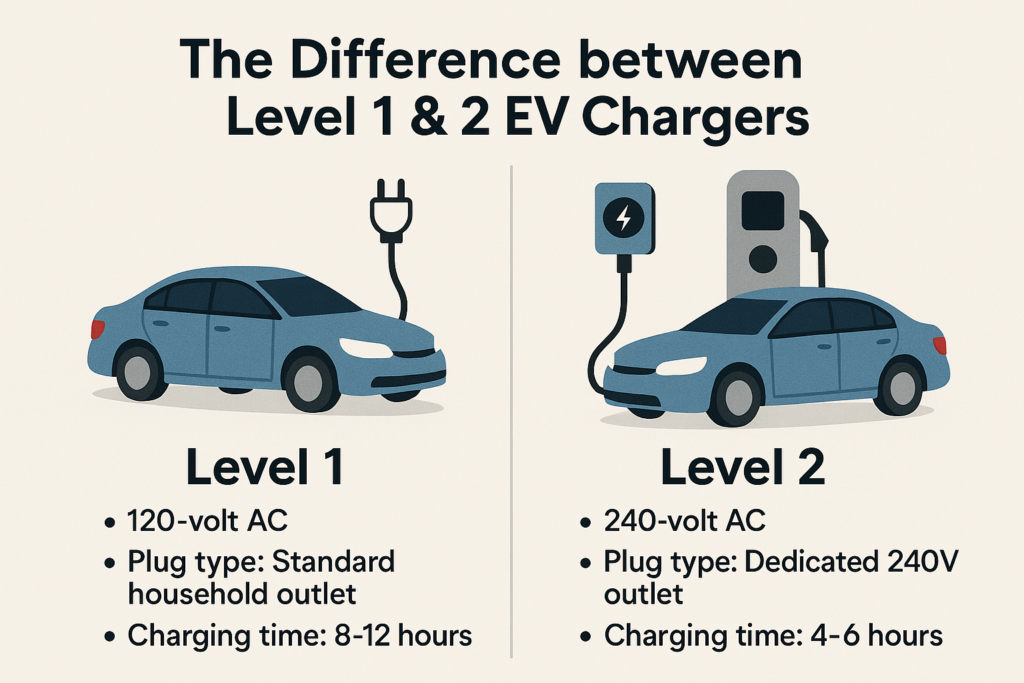
Charger installation rebates: Many utilities offer rebates for installing Level 2 home chargers. ComEd in Illinois has launched a $70 million EV rebate program. Austin Energy in Texas offers rebates of up to $1,200.
Time-of-use electricity rates: Many utilities offer special EV charging rates that significantly reduce the cost of charging overnight. These rates can save hundreds of dollars per year compared to standard residential rates.
Income-qualified programs: Several states offer enhanced incentives for low-income residents. New Jersey’s Charge Up+ provides an additional $2,500 for income-verified applicants. Connecticut’s Rebate+ provides an additional $3,000 for income-qualified residents.
Other EV Perks by State
Beyond direct financial incentives, many states offer other benefits that can significantly improve the EV ownership experience:
HOV lane access: California, New York, and several other states allow EVs to use high-occupancy vehicle (HOV) lanes regardless of the number of passengers. This can save substantial time in congested urban areas.
Sales tax exemptions: Virginia exempts EVs from retail sales and use tax. New Jersey offers sales tax exemption on EV purchases. These exemptions can save thousands of dollars on the purchase price.
Reduced registration fees: Some states offer reduced registration fees for EVs, though others have introduced additional fees to compensate for lost gas tax revenue.
How to Stack Incentives
One of the most important things to understand about EV incentives is that many can be stacked. A buyer in a state with generous incentives can often combine:
- State rebate or tax credit (e.g., California’s $3,500 MyFirstEV rebate)
- Utility rebate (e.g., ComEd’s EV rebate in Illinois)
- Federal charger tax credit (30% up to $1,000, expiring June 30, 2026)
- Sales tax exemption (where available)
- Time-of-use electricity rates (ongoing savings)
In California, for example, a first-time EV buyer can receive the $3,500 state rebate, claim the federal charger credit, and benefit from time-of-use rates. In New Jersey, a buyer can stack the $4,000 Charge Up+ rebate with sales tax exemption and utility incentives.
What This Means for Today’s EV Buyers
The honest assessment
The 2026 EV incentive landscape is a patchwork. Some states have stepped up aggressively to fill the federal gap. California, Colorado, and New Jersey offer substantial support. Others have done little or nothing. And a few have never offered meaningful incentives at all.
The best states for EV incentives in 2026
- California: $3,500 rebate for first-time buyers, HOV access
- Colorado: Up to $3,250 state tax credit for low-cost EVs
- New Jersey: Up to $4,000 (standard + income-qualified)
- Massachusetts: Up to $4,500 MOR-EV rebate
- Connecticut: Up to $4,500 for new EVs, $5,000 for used
- Illinois: $2,000 rebate ($4,000 for low-income)
- New York: Up to $2,000 Drive Clean rebate
- Oregon: $2,000 standard rebate (limited window)
- Pennsylvania: Up to $4,000 for low-income buyers
- Rhode Island: Up to $3,000
The worst states for EV incentives in 2026
States with no statewide purchase incentives: Arizona, Florida, Georgia, Virginia, and Washington. Buyers in these states should focus on utility incentives and the federal charger credit.
Should you wait for better incentives?
The honest answer: it depends on where you live. In states with strong programs, now is a good time to buy. In states with no incentives, waiting is unlikely to improve the situation significantly. The federal government has shown no indication of reinstating the $7,500 tax credit. State programs are the primary source of support, and they are unlikely to become more generous in the current political environment.
The charger credit deadline
If you are planning to buy an EV and install a home charger, you should act before June 30, 2026. The federal charger tax credit (30% up to $1,000) expires on that date. After that, you will not be able to claim this credit.
Internal Links: Further Reading on Clean Energy Bazaar
The 2026 EV buyer’s guide: a state-by-state incentive checklist for the US connects to the EV market and policy guides on cleanenergybazaar.com.
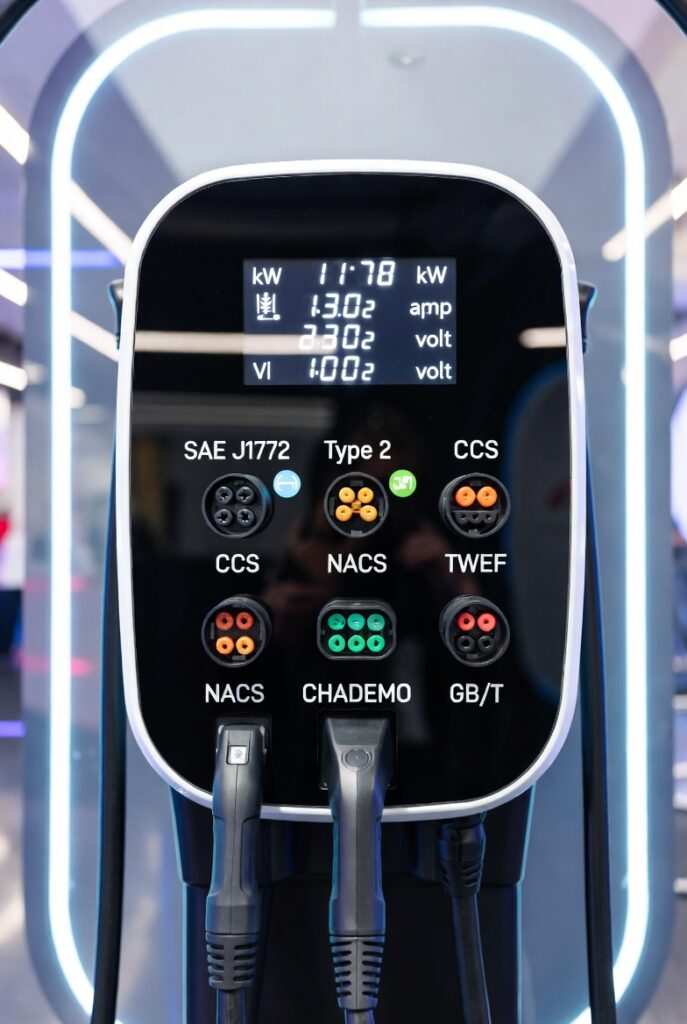
For the US EV sales slump guide covering the market context, our US EV sales slump 25% – policy uncertainty and the hybrid pivot guide covers the federal policy changes that created the need for state incentives. For the NACS vs. CCS guide covering the charging standard transition, our NACS vs. CCS: what does the standardization (SAE J3400) mean for US drivers? guide covers the connector standard that affects which chargers you can use. For the NEVI’s new rules guide covering charging infrastructure standards, our NEVI’s new rules: 97% uptime + 150kW – the US raises the bar for public chargers guide covers the federal reliability standards for public charging. For the nation-by-nation BEV penetration ranking covering where the US stands globally, our nation-by-nation BEV penetration ranking: Norway at 97.9%, Denmark at 80%, US at 5.9% guide covers the global EV adoption landscape.
Final Thoughts
2026 EV buyer’s guide: a state-by-state incentive checklist for the US — and the honest answer is that where you live matters more than ever.
The federal $7,500 tax credit is gone. The federal $4,000 used EV credit is gone. The federal government has withdrawn from supporting EV adoption. What remains is a patchwork of state programs that range from generous to non-existent.
California offers $3,500 to first-time buyers. Colorado offers up to $3,250 in state tax credits. New Jersey offers up to $4,000. Massachusetts offers up to $4,500. These states have stepped up to fill the gap.
But other states have done little or nothing. Arizona, Florida, Georgia, Virginia, and Washington offer no statewide purchase incentives. Buyers in these states must rely on utility programs, local incentives, and the soon-to-expire federal charger credit.
The charger credit expires on June 30, 2026. After that, even that small federal support will be gone.
The honest verdict: the 2026 EV buyer’s landscape is more fragmented than ever. The best deals are in states that have chosen to support the transition. The worst deals are in states that have chosen not to. Before you buy, check your state’s program. Check your utility’s program. Check the deadlines. And if you are installing a home charger, do it before June 30.
The federal support is gone. The states are on their own. And so are you.