The 59 pilot counties represent a specific, named, policy-backed initiative within China’s rural EV charging infrastructure programme that most English-language coverage of China’s EV market has largely missed — which is understandable, because the initiative is specifically rural, specifically county-level, and specifically unglamorous in the way that rural infrastructure investment tends to be unglamorous compared to the headline-grabbing urban EV stories that dominate English-language media.
But the 59-county rural charging pilot deserves serious attention from anyone interested in the business opportunity landscape of China’s EV charging market in 2026, because it represents something increasingly rare in China’s EV charging industry: a market with genuine demand growth, meaningful government financial support, and — critically — competitive dynamics that have not yet been shaped by the great shakeout covered in our dedicated guide. The rural charging market that the pilot counties represent is not the saturated, margin-compressed, consolidating urban market. It is an earlier-stage market, with the opportunities and risks that early-stage markets always present.
This guide on rural charging boom 2026 how to start a charging business in China’s 59 new pilot counties provides the complete honest business assessment — what the pilot county programme specifically entails, the actual demand profile that rural county EV charging serves, the specific infrastructure and regulatory requirements, the financial model that rural charging businesses can realistically build, the specific risks that English-language coverage consistently underestimates, and the practical steps for anyone seriously considering entering this market.
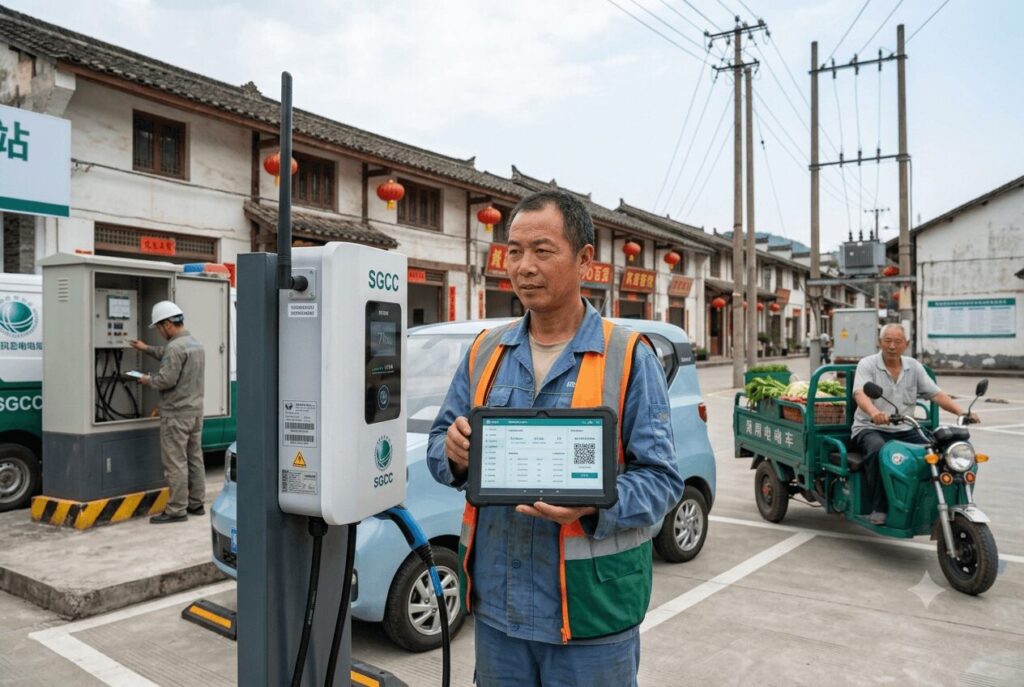
The 59 Pilot Counties — What the Programme Actually Is
The Policy Foundation
The specific programme context:
China’s Ministry of Agriculture and Rural Affairs (农业农村部), in coordination with the National Energy Administration (国家能源局) and NDRC, has designated a specific cohort of rural counties across multiple provinces as pilot areas for accelerated rural EV charging infrastructure deployment — the cohort that has come to be referred to as the “59 pilot counties” in domestic policy discussion, reflecting the specific number of counties receiving the highest tier of policy support in the most recent programme round.
What “pilot county” designation specifically provides:
The designation is not merely symbolic. Counties designated as rural EV charging pilots receive specific, documented policy support that distinguishes them from surrounding non-pilot areas:
Central government subsidy access: Designated pilot counties’ approved charging infrastructure projects gain access to central government subsidies specifically earmarked for rural charging infrastructure, channelled through the Ministry of Finance’s rural energy transition funding mechanisms, at rates typically covering 20-40% of approved project costs.
Priority grid connection support: State Grid and Southern Grid have issued specific commitments to prioritise rural charging infrastructure connection applications in designated pilot counties, with expedited review timelines (typically 15-30 days for standard rural charging installations in pilot counties, compared to the more variable and often longer timelines in non-designated rural areas covered in our rural tier 1 vs tier 2 guide).
Provincial co-funding unlocking: The central government designation typically triggers matching provincial government co-funding commitments, meaning the effective subsidy rate for approved projects in pilot counties often exceeds the central government rate alone — with combined central-plus-provincial support potentially reaching 40-60% of project costs in the most supportive provincial environments.
Procurement and permitting simplification: Pilot county designations often include specific administrative simplification measures — streamlined land use approvals for charging station site selection, simplified grid connection permitting, and in some cases, pre-approved site categories (township government compounds, village committee premises, rural market sites) where charging infrastructure can be installed under simplified approval procedures.
The Geographic Distribution of the 59 Pilot Counties
The provincial coverage:
The 59 pilot counties are distributed across multiple provinces with specific concentration in regions that combine:
- High rural EV adoption momentum (provinces where rural NEV subsidy programmes have driven meaningful penetration of EVs and PHEVs into rural household vehicle fleets)
- Identified infrastructure gaps (counties where the rural EV population has grown faster than charging infrastructure has been deployed)
- Administrative capacity for programme management (counties with sufficient government administrative capability to manage the programme’s reporting and compliance requirements)
Prominent provincial concentrations include:
Hunan, Hubei, and Henan (central China provinces with significant rural EV adoption driven by local vehicle subsidy programmes) represent a meaningful proportion of the pilot county designations. Sichuan (where the rural EV adoption documented in Teacher Zhao’s story in our user stories guide is representative of broader trends) has multiple designated counties. Guangdong and Shandong, as large provinces with both rural populations and relatively high vehicle ownership rates, also have significant representation.
The non-uniformity that business planning must account for:
Despite the common “pilot county” designation, the 59 counties are not uniform in their commercial attractiveness — they span a range of population density, income level, existing EV penetration, and current charging infrastructure baseline that produces meaningfully different commercial opportunity profiles within the same programme tier. Business planning that treats “pilot county” as a uniform category rather than investigating the specific characteristics of specific target counties will systematically misestimate commercial opportunity.
The Rural EV Charging Demand Profile — Who Is Actually Driving in These Counties
The Real Rural EV Market — Significantly Different From Urban Assumptions
The vehicle profile:
Rural Chinese EV adoption, as documented throughout our rural-specific content and our user stories guide, has a distinctly different vehicle composition from urban markets that fundamentally shapes the charging demand profile:
Micro EVs and entry-level EVs predominate:
Wuling Hongguang Mini EV, BYD Seagull, Chery QQ Ice Cream, and similar vehicles priced below ¥60,000 represent the dominant purchased vehicle type in most rural county areas. As covered in our Xiaomi SU7, Zeekr, Wuling Mini EV guide, these vehicles have small batteries (9-30 kWh) and charge from standard sockets at 2.2-3.3 kW — creating charging demand that is satisfied by much simpler and lower-cost infrastructure than premium urban EV charging requires.
PHEVs and EREVs for longer-distance needs:
As documented in our Li Auto and rural charging content, households with longer-distance travel requirements — county-seat businesses travelling to prefecture-level cities, rural contractors, agricultural product traders — have gravitated toward PHEVs and EREVs rather than pure BEVs, exactly because rural charging infrastructure inadequacy has made range anxiety a genuine and legitimate concern. These vehicles’ home charging primarily serves electric-mode optimisation rather than primary range provision, meaning lower daily charging volume than pure BEV equivalents.
Agricultural and commercial electric vehicles:
A specifically rural vehicle category largely absent from urban EV charging discussions: three-wheeled electric farm vehicles (电动三轮农用车), electric delivery vehicles for rural logistics, and in some areas electric agricultural machinery — all of which create charging demand distinct from both passenger car home charging and urban public charging.
The Demand Pattern That Rural Charging Infrastructure Must Serve
The temporal concentration:
Rural vehicle usage patterns create specific charging demand temporality that commercial infrastructure planning must accommodate:
Agricultural season peaks: During major agricultural activity periods (spring planting, autumn harvest), vehicle usage intensity increases sharply as farm owners, agricultural service providers, and rural traders increase daily mileage significantly. Charging demand peaks during these periods in ways that don’t occur in urban markets with more consistent year-round usage.
Market day concentration: Many rural county areas retain traditional market day (赶集) cycles where commercial activity, vehicle travel, and consequently charging demand concentrates on specific days of the week or specific dates of the month — potentially creating 3-4× demand spikes on market days compared to non-market days at the same location.
Festival season travel: As covered in our Spring Festival guide, rural EV owners travelling back to their home villages during major holidays create temporary but intense charging demand surges at county-level charging hubs that serve as de facto aggregation points for rural travel.
The Charging Location Types That Serve Rural Demand
Location category 1: Township-level (乡镇) commercial hubs
The township commercial area — typically the largest concentration of retail, services, and business activity within the administrative unit below the county seat — represents the primary location type for rural charging infrastructure serving both township residents and surrounding village residents travelling for commercial purposes.
Commercial rationale: Township commercial areas generate dwell time from shopping, service, and commercial transactions — providing the 20-60 minute charging windows during which AC charging meaningfully supplements vehicle batteries even at slower rural-appropriate AC speeds.
Location category 2: County seat (县城) fast charging
The county seat represents the highest-traffic location within each county, the most accessible for a broader geographic area’s vehicle population, and the location most likely to serve the PHEVs and BEVs with larger batteries that benefit most from DC fast charging capability.
Commercial rationale: County seats typically have adequate grid infrastructure for DC fast charging, the highest concentrations of rural EV owners and travellers, and existing commercial areas that can provide the retail environment for productive waiting during charging sessions.
Location category 3: Village-level basic charging
Individual villages, or small clusters of adjacent villages, potentially served by basic AC charging points at the village committee (村委会) premises, rural cooperative facilities, or rural retail locations — providing within-village or near-village charging access that reduces the need for village residents to travel to the township level for routine charging.
Commercial rationale: More challenging commercially than the first two categories because of lower traffic volumes, but potentially addressable through lower-cost simple infrastructure (standard AC points, lower specification, simpler installation) and community-cooperative business models rather than profit-seeking commercial models.
The Financial Model — What Rural Charging Businesses Can Realistically Expect
The Revenue Components
Revenue stream 1: Charging service fees
The primary revenue for any commercial charging station is the per-kWh or per-session service fee charged to users above the electricity cost.
Rural county-appropriate service fee structure:
As documented in our ROI calculator and TOU savings guides for urban home charging, the economics of EV charging service fees are constrained by the alternative cost of home charging (approximately ¥0.25-¥0.34/kWh at valley rates in the provinces where pilot counties are predominantly located). Public charging service fees that significantly exceed home charging economics face adoption resistance.
The rural pricing equilibrium:
Rural county public charging service fees have generally settled in the range of ¥0.35-¥0.65/kWh above electricity cost (service fee component), depending on the location’s traffic, the charger specification (DC versus AC), and the competitive environment. For a rural AC charging point:
Electricity cost to operator: approximately ¥0.45-¥0.55/kWh (commercial rate, including rural commercial electricity pricing)
Service fee added: ¥0.35-¥0.55/kWh
Total user price: approximately ¥0.80-¥1.10/kWh for rural AC public charging
At ¥0.90/kWh average and an AC charging point delivering 3.5-7 kW, the revenue per hour of active charging:
3.5 kW × ¥0.90 = ¥3.15/hour or 7 kW × ¥0.90 = ¥6.30/hour
Revenue stream 2: Government subsidies
As established in the pilot county programme overview, approved projects in designated pilot counties receive 20-40% central government subsidies plus provincial matching, reducing the upfront capital requirement and improving investment economics significantly compared to non-subsidised rural charging investments.
Revenue stream 3: Ancillary commercial activity
Charging stations that create dwell time — during which the vehicle owner remains at or near the charging location — can generate ancillary commercial revenue from retail sales, food and beverage, maintenance services, or other commercial activities. In rural county contexts, this is often more relevant than in urban contexts because rural charging locations are more likely to be associated with existing commercial establishments (rural service stations, township market facilities) than purpose-built charging-only infrastructure.
Revenue stream 4: Demand response participation
As covered in our local rebates and technology trends guides, OCPP-compliant chargers can participate in demand response programmes generating ¥200-¥800/year per point in pilot cities. Rural pilot county deployment may include specific demand response programme access as part of the pilot programme design, though this remains less developed than the urban pilot programmes covered in those guides.
The Cost Structure
Capital costs (per AC charging point, rural county context):
Equipment (7 kW AC certified commercial point): ¥1,800-¥3,500
Grid connection and electrical installation: ¥2,000-¥8,000 (wider range than urban due to rural grid infrastructure variation)
Civil works (concrete pad, weatherproof enclosure if outdoor): ¥500-¥2,000
Management system and connectivity: ¥300-¥800 (portion of shared management platform cost)
Total per point: approximately ¥4,600-¥14,300 before subsidies
After pilot county subsidies (30-50% average for approved projects): ¥2,300-¥10,000 net cost per point
Ongoing operating costs (per AC charging point, annual):
Electricity cost passthrough (included in revenue calculation above)
Management platform subscription: ¥200-¥600/year
Maintenance (including the schedule covered in our maintenance guide): ¥300-¥800/year
Depreciation provision (7-10 year equipment life): ¥460-¥1,430/year
Site lease (if not owned): ¥0-¥3,000/year
Total annual operating cost (excluding electricity passthrough): approximately ¥960-¥5,830/year per point
The Utilisation Rate — The Critical Business Variable
Why utilisation rate is the primary determinant of rural charging business viability:
Unlike urban charging where high traffic density creates relatively predictable utilisation, rural charging infrastructure faces genuinely uncertain and highly variable utilisation depending on local EV population size, competing charging alternatives, and the specific location’s traffic characteristics.
The utilisation rate ranges documented in rural Chinese charging:
Low-traffic rural village charging points: 0.5-2 sessions per day average
Township commercial area charging: 3-8 sessions per day average
County seat fast charging: 8-20 sessions per day average
Market day peaks: 2-5× daily average on designated market days
The break-even utilisation calculation:
For a 7 kW AC charging point with ¥7,500 net capital cost (after subsidy), ¥2,000 annual operating cost, and ¥0.40/kWh net service fee margin:
Annual revenue needed to cover costs: ¥7,500 amortised over 8 years + ¥2,000 = ¥2,937.50/year
Required annual kWh throughput: ¥2,937.50 ÷ ¥0.40 = 7,344 kWh/year
Required daily sessions (at 10 kWh/session): 7,344 ÷ 10 ÷ 365 = 2.01 sessions/day break-even
The honest utilisation assessment:
2 sessions/day break-even is achievable at township commercial locations but marginal for village-level installations. This is why the location selection decision — specifically the sub-county-level site selection within any given pilot county — is the most consequential decision in rural charging business planning, far more consequential than equipment specification choices or financing arrangements.
The Practical Steps — How to Actually Enter This Market
Step 1: Confirm Target County Designation and Specific Programme Terms
Before any other business planning step:
Confirm whether your target county is among the current designated pilot counties — the specific list is available through the Ministry of Agriculture and Rural Affairs’ rural energy transition programme documentation, through the local county government’s development and reform bureau, or through the State Grid/Southern Grid rural charging programme offices that are often the primary liaison point for pilot county programme implementation.
Critically, confirm the specific subsidy terms applicable in your target province and county — subsidy rates, eligible project types, application timelines, and compliance requirements vary meaningfully between provinces even within the same central programme framework.
Step 2: Conduct Specific Local EV Population and Traffic Assessment
The data that makes or breaks the business case:
Before committing any capital, conduct a specific, local assessment of:
Registered EV and PHEV count in the target area — accessible through the county-level traffic management bureau (交通管理局) vehicle registration data, sometimes available on request, or through proxy indicators like local dealership sales records and rural subsidy programme beneficiary lists.
Existing charging infrastructure inventory — both formal commercial charging points and informal home-charging-only situations (owners who charge at home but would use public charging if available) — to understand the gap between current provision and addressable demand.
Local traffic flow at candidate charging locations — this requires direct observation, ideally across different days of the week and different times of day, to assess realistic session potential rather than relying on theoretical calculations alone.
Step 3: Engage the Local Grid Company Early
The rural grid constraint that determines everything:
As covered extensively in our rural tier 1 vs tier 2 guide, rural electrical infrastructure capacity is the primary limiting factor for rural charging business deployment. A township commercial location that is commercially ideal may be grid-constrained in ways that either make installation impossible, require expensive grid upgrades that eliminate the business case, or require equipment specification adjustments (lower power rating, more charging points sharing a limited grid connection) that affect the revenue model.
Early engagement with the local 农村供电所 (rural electricity supply bureau) to understand the available grid capacity at candidate locations, the cost and timeline of any required grid upgrades, and the specific connection process for commercial charging installations in the pilot county context, is essential before finalising site selection or financial projections.
Step 4: Apply for Pilot County Subsidies Before Equipment Purchase
The sequencing that maximises subsidy access:
Pilot county subsidies are typically administered through an application and approval process — projects are approved for subsidy before (or concurrent with, in some programmes) construction begins, rather than retroactively reimbursing already-completed projects. Starting construction before completing the subsidy application process risks either disqualification from subsidy (if the programme requires pre-approval) or unnecessary delay waiting for subsidy approval that could have been obtained before equipment ordering.
The subsidy application typically requires: project location description and site control documentation (lease or ownership), proposed equipment specification and supplier documentation, grid connection pre-assessment from the local supply bureau, and a basic business plan or project development plan satisfying the programme’s eligibility criteria.
Step 5: Select Equipment Appropriate to Rural Context
The specific rural equipment selection criteria that differ from urban residential guidance:
Wide voltage input tolerance (180V-264V) as covered in our rural tier 1 vs tier 2 guide — essential for rural grid voltage fluctuation that doesn’t affect urban installations but creates functional problems for equipment with standard ±10% voltage tolerance.
IP65 minimum for any outdoor installation — consistent with our weatherproof guide’s guidance but now applied to commercial rather than residential equipment, with the same underlying climate-specific reasoning.
OCPP compliance (at minimum 1.6, preferably 2.0) for management platform integration, payment processing, subsidy compliance reporting, and potential demand response programme participation — all specifically required in the pilot county commercial context rather than being optional value-adds as in some residential scenarios.
Cold weather specification appropriate to the specific pilot county’s climate — the significant geographic distribution of the 59 counties means some are in genuine cold-weather regions requiring the -30°C specification covered in our winter charging guide, while others are in subtropical environments where this specification is irrelevant.
Step 6: Implement the Management Platform and Payment System
The operational infrastructure that commercial rural charging requires:
Unlike residential home charging where the primary “management platform” need is a consumer smartphone app, commercial rural charging requires a management platform that handles:
QR code-initiated payment sessions compatible with Alipay, WeChat Pay, and digital yuan as covered in our connectivity guide — standard for any commercial charging deployment in China regardless of rural versus urban context.
Real-time monitoring and fault detection across all points in the installation — essential for a rural commercial operator who cannot be physically present at the installation at all times and needs remote visibility into operational status.
Session logging and reporting for subsidy compliance documentation — many pilot county subsidy programmes include ongoing reporting requirements that the management platform must support.
Revenue accounting and settlement with the electricity utility for the commercial charging tariff arrangement.
The Honest Risk Assessment — What Rural Charging Business Plans Often Miss
Risk 1: EV Population Growth Rate Uncertainty
The honest uncertainty:
Rural EV adoption projections are genuinely uncertain in ways that urban projections (where market signals are denser and historical patterns better established) are not. A pilot county charging investment based on projected EV population growth rates that prove optimistic creates a utilisation gap that directly translates into insufficient revenue to cover operating costs and debt service.
The mitigation: Base business cases on confirmed current EV population rather than projected future population, with upside scenario modelling for growth but financial structure that survives the conservative scenario.
Risk 2: Grid Upgrade Cost Surprises
The frequently underestimated cost driver:
As Teacher Zhao’s experience in our user stories guide illustrated at the household level, rural grid infrastructure surprises are common — costs and timelines for grid upgrades or new connections frequently exceed initial estimates from the rural supply bureau, sometimes significantly, in ways that don’t typically occur in urban installations where grid infrastructure is more mature and standardised.
The mitigation: Obtain firm written cost estimates from the rural supply bureau before finalising financial projections, and include a 30-50% contingency on grid connection cost estimates specifically.
Risk 3: Subsidy Programme Continuity
The policy dependency risk:
Rural charging subsidies are programme-specific rather than permanent entitlements — they depend on continued government budget allocation, programme renewal decisions, and continued priority for rural charging infrastructure within the broader EV policy landscape. A business model that depends on continued subsidy receipt for ongoing profitability (as opposed to a business that uses subsidies to reduce initial capital cost but is sustainable at current utilisation without ongoing subsidy) carries this policy dependency risk.
The mitigation: Design the business to achieve operational profitability (covering operating costs and cost of capital) at achievable utilisation rates without ongoing subsidy dependence, using subsidies specifically to reduce initial capital cost and improve return on investment rather than as a recurring operating support mechanism.
Risk 4: Competition From Grid Company Deployment
The specific rural market competition dynamic:
State Grid and Southern Grid are themselves deploying rural charging infrastructure under their own rural electrification and NEV infrastructure mandates, sometimes in direct competition with private commercial charging operators. In some pilot county areas, grid company deployment has preceded or crowded out private commercial deployment — understanding the grid company’s own deployment plans in the specific target area is essential competitive intelligence before committing private capital.
The mitigation: Engage directly with the local rural supply bureau not only about grid connection requirements but about their own deployment plans — rural supply bureau staff will generally be transparent about planned grid company-owned charging installations, enabling site selection that complements rather than directly competes with planned grid company deployment.
Internal Links — Further Reading on Clean Energy Bazaar
The rural charging boom 2026 how to start a charging business in China’s 59 new pilot counties guide connects to the technical, financial, and geographic guidance throughout this content cluster.
For the rural tier 1 vs tier 2 guide that establishes the rural electrical infrastructure context that this business guide builds upon, our tier 1 vs tier 2 city charging solutions for Beijing high-rises vs Chengdu villas vs rural villages guide covers every rural infrastructure consideration. For the ROI calculator that provides the financial modelling framework adapted for rural commercial charging in this guide, our EV home charger ROI calculator 2026 when it pays off with local rebates included guide covers the complete financial assessment methodology. For the real user stories guide featuring Teacher Zhao’s genuine rural EV charging experience that informs this guide’s rural market characterisation, our user stories real EV charger setups from Chinese drivers from Shenzhen taxis to Hainan tourists guide covers eight first-person accounts including rural scenarios. For the local rebates guide covering the subsidy structures that rural pilot county programmes build upon, our local utility rebates for EV charging 2026 Shenzhen Shanghai Beijing guide covers the national subsidy framework. For the great shakeout guide contextualising rural charging as a differentiated opportunity from the consolidating urban market, our great shakeout why 80 percent of Chinese EV charger manufacturers face elimination in 2026 guide covers the complete industry landscape. And for the government fleet charging guide that pairs with this rural commercial opportunity in terms of structured non-residential demand, our public sector opportunity guide to China’s 25 percent government fleet charging mandate guide covers the institutional procurement landscape.
Final Thoughts
The rural charging boom 2026 how to start a charging business in China’s 59 new pilot counties opportunity is genuine — but it is also specific, granular, and significantly more dependent on location-level detail than the headline “rural charging boom” framing suggests. The distinction between a township commercial location that achieves 5-6 sessions per day and a village-level location that achieves 0.5 sessions per day is the difference between a profitable business and an unviable one, and this distinction plays out at the level of specific sites within specific counties rather than at the level of the pilot programme designation itself.
The pilot county designation matters because it provides the subsidy access, the grid connection priority, and the administrative simplification that makes rural charging investment viable at utilisation levels that wouldn’t support the same investment at market rates in non-designated areas. But the designation is a necessary rather than sufficient condition for a successful rural charging business — necessary because without it the economics typically don’t work, but not sufficient because the economics still depend on the specific site, specific EV population, specific grid capacity, and specific competitive environment of each individual installation.
For entrepreneurs and investors approaching this market with honest assessment of these location-level specifics, confirmed subsidy access, early grid company engagement, conservative utilisation-based financial models, and equipment specification appropriate to rural operational realities — the 59 pilot counties represent a genuinely differentiated market opportunity in a sector that, at the urban residential level, has largely been defined by the consolidation and margin compression covered in our great shakeout guide.
Rural charging in China’s pilot counties isn’t the easy money that any government-backed programme description can make it sound like. It is specific, detailed, operationally demanding work in markets that require local knowledge and local relationships alongside the technical and commercial capabilities that urban charging experience provides. For the participants who approach it with that honest understanding, it is also a genuine and growing opportunity in one of the largest EV markets on earth.