EV charging

Weatherproof Ratings Explained: What Chargers Work Best in Extreme Conditions (India 2026 Guide)

ndia’s unpredictable weather—scorching 45°C+ summers, torrential monsoons, coastal humidity, and northern dust storms—puts home EV chargers through one of the toughest real-world tests anywhere. A poorly sealed charger can fail during peak rain, overheat in summer, or get damaged by accidental knocks, leading to costly repairs or unreliable charging.
The secret to long-term reliability lies in IP (Ingress Protection) and IK (Impact Protection) ratings. IP65+ (dust-tight and protected against powerful water jets) combined with IK08+ (impact resistance) is now the minimum standard for outdoor or semi-exposed installations in most Indian cities.
This 2026 guide explains:

What IP65, IP66, IK08, and IK10 ratings actually mean in practical terms
Which ratings suit open parking, balconies, coastal areas, or extreme heat zones
Top weatherproof chargers that consistently perform across Bengaluru monsoons, Delhi summers, Mumbai humidity, and more:
Tata Power EZ Charge (IP65 / IK08 – proven all-rounder)
Delta AC Mini (IP65 / IK10 – fanless & heat-resistant)
Exicom Spin, Bolt.Earth, and Victron models

Plus quick buying tips, installation best practices (canopy use, surge protection), and a comparison table to match your exact mounting location and climate.
Whether your charger faces direct rain, dust, or blazing sun, choosing the right weatherproof rating can save you thousands in downtime and repairs. Read the full guide to pick a durable, future-proof home EV charger built for India’s extremes.

EV charging

Solar Integration: Which Chargers Work Best with Home Solar Systems? (India 2026 Guide)

With rooftop solar installations surging across Indian homes and EV adoption accelerating, combining the two has become one of the most powerful ways to slash running costs to near-zero during daylight hours.
In 2026, smart home EV chargers with solar-priority modes, dynamic load management, and seamless integration with popular hybrid inverters (Tata Power Solar, Growatt, Luminous, Microtek, Victron, etc.) allow you to charge your electric vehicle almost entirely on free solar surplus—often achieving ₹0.5–1 per km effective cost instead of ₹7–10/unit grid rates.
Whether you already have a 5–10 kW rooftop system or are planning one alongside your next EV purchase, the right charger can unlock massive monthly savings (₹3,000–₹6,000+ for typical 50–100 km daily drivers in cities like Bengaluru).
This guide compares the top solar-compatible chargers available in India right now:

Tata Power EZ Charge – native solar priority & Tata ecosystem integration
Delta AC Mini – versatile Modbus support for most hybrid inverters
Exicom, Bolt.Earth, Victron – advanced excess-solar charging logic

Plus real-world savings examples, installation best practices, and a quick-decision table to match your solar setup.
If you’re tired of high electricity bills or want to maximize every unit your panels generate, read the full article to find the best solar-ready EV charger for your home in 2026.

EV charging

Apartment vs House EV Charging Solutions: Complete Guide for India (2026)

Apartment vs House EV Charging Solutions: Complete Guide for India (2026)
Electric vehicles (EVs) are transforming mobility across India, with sales continuing to grow rapidly and public charging infrastructure expanding under schemes like PM E-DRIVE. However, for the vast majority of EV owners, reliable and affordable charging at home remains the single most important factor for hassle-free ownership.
Where you live—whether in an independent house or an apartment complex—dramatically affects your charging options, installation costs, daily convenience, monthly running expenses, and even long-term property value.
This complete 2026 guide compares both scenarios with updated costs, real-world challenges, available solutions, and practical recommendations tailored to Indian conditions.
Why Home Charging Still Wins in India
Home charging delivers the lowest cost per kilometre in the country. Overnight Level-2 charging typically works out to ₹1–2 per km, compared to ₹4–6+ per km on most public DC fast chargers. For anyone driving 50–100 km per day, home charging usually saves thousands of rupees every month over public-station dependency.
Residential electricity tariffs (₹7–10/unit in most states) and the growing availability of night-time EV-specific slabs make home charging even more attractive in 2026.
EV Charging Solutions for Independent Houses
Key Advantages

Complete control over installation and placement
Dedicated parking space or garage
Lowest electricity cost using residential rates
Straightforward integration with rooftop solar systems
Significant boost to property resale value (often 5–8%)

Typical Installation Process

Assess your home’s electrical load and available capacity (most require a dedicated 7–11 kW circuit).
Engage a certified electrician and (optionally) apply for a separate EV meter through your DISCOM.
Install a wall-mounted AC charger (Type-2 or CCS2 connector).
Add smart features such as app-based scheduling, energy monitoring, and load balancing.

2026 Cost Breakdown

7.4 kW smart charger: ₹35,000–₹70,000
Wiring, MCB, earthing, and labour: ₹15,000–₹35,000
Separate EV meter (optional but recommended): ₹3,000–₹6,000
Total one-time investment: ₹55,000–₹1,00,000

Popular & Reliable Home Charger Brands in 2026

Tata Power EZ Charge
Delta AC Mini
Exicom Spin
Victron Energy
Zeconex
Magenta ChargeGrid home models

All of the above are BEE-star-rated or OCPP-compliant with mobile app control.
EV Charging Solutions for Apartments – The Bigger Challenge
Apartment residents face several common obstacles:

Requirement for RWA / society approval
Shared parking areas with no personal wall space
Stricter fire-safety norms for basement parking (NBC guidelines)
Concerns around equitable billing and load management

Despite these hurdles, 2026 has seen a sharp increase in apartment societies adopting EV charging as a standard amenity, especially in metros like Bengaluru, Pune, Hyderabad, and NCR.
Current Practical Solutions

Society-Level Shared Charging Infrastructure (Most Common & Recommended)
4–20 AC chargers installed in common parking zones
Pay-per-use model via mobile app (₹12–18 per kWh in most cities)
Managed by third-party operators (Bolt.Earth, Statiq, Tata Power, ChargeGrid, Kazam, etc.)
RWA pays nothing upfront in many revenue-share models

Individual Dedicated Charging Point (If RWA Permits)
Run a dedicated cable from your household meter to your parking slot
One-time cost: ₹40,000–₹90,000
Many progressive societies now allow this after seeing successful implementations

Portable / Plug-in Chargers (Temporary Workaround Only)
Use a 3.3–7.4 kW portable charger with an existing 15A/16A socket
Slow charging and higher safety risk if used long-term
Not recommended as a permanent solution

Apartment vs Independent House: Side-by-Side Comparison (2026)

FactorIndependent HouseApartment ComplexOne-time Setup Cost₹55,000 – ₹1,00,000₹0 (shared) or ₹40,000 – ₹90,000 (individual)Monthly Charging Cost (50–100 km/day)₹1,200 – ₹2,500₹1,800 – ₹3,500 (shared tariff)Typical Home Charging Speed7–11 kW (4–6 hours full charge)3.3–7.4 kW (shared points)Daily ConveniencePark and plug anytimeDepends on availability & booking systemApprovals RequiredElectrical safety clearance onlyRWA / society committee + possibly DISCOMSolar Panel IntegrationEasy and highly cost-effectiveDifficult unless society installs central solarImpact on Property Value+5–8%+3–6% (EV-ready societies command premium)
Important Factors to Consider Before Buying an EV

Daily commute distance — Under 80 km/day? Even a 3.3 kW charger is usually sufficient.
Society / RWA policy — Check existing rules or WhatsApp group discussions before purchasing an EV.
Night-time tariffs — Many states now offer ₹5–7/unit EV slabs after 10 PM.
Safety first — Always choose chargers with Type-B RCCB, surge protection, and BEE / ARAI certification.

Government Support & Incentives Still Active in 2026

PM E-DRIVE scheme extended
Continued subsidies for public & semi-public charging infrastructure
Several states offer additional rebates for apartment society installations
Preference given to BEE 3–5 star-rated chargers

Future-Proof Recommendation
Whether you live in a house or an apartment, opt for smart, OCPP-compliant chargers with app control, scheduling, and load-balancing features. These models are ready for upcoming V2G (vehicle-to-grid), solar+storage integration, and dynamic pricing that will become mainstream by 2027–28.
Final Verdict for 2026 Buyers

Independent house owners → Install a dedicated 7.4 kW smart wall charger + consider rooftop solar for maximum savings and convenience.
Apartment residents → Actively push your RWA / managing committee for shared smart charging infrastructure. Societies with EV-ready facilities are already seeing faster flat sales and higher resale values in major cities.

Charging infrastructure is no longer an afterthought—it is now one of the most important decisions when buying an EV in India. Plan your charging solution first, then choose your vehicle.
Have questions about your specific society or home setup? Drop your city and parking situation in the comments—we’ll recommend the best options available in your area.
Related Articles

Best Home EV Chargers Under ₹60,000 in India 2026
How to Convince Your Apartment RWA to Install EV Chargers

EV charging

Budget EV Chargers Under ₹500: Are They Worth Considering in 2026?

Budget EV Chargers Under ₹500: Are They Worth Considering? – Quick Excerpt

In India’s booming electric two-wheeler market, spare chargers for Ola S1, Ather Rizta, TVS iQube, and countless e-bikes often tempt buyers with prices as low as ₹299–₹499 on Amazon and Flipkart. These generic 48V/60V lithium chargers promise auto cut-off, LED indicators, and fast charging — but do they deliver safely?

The Appeal
Ultra-cheap, next-day delivery, lightweight, and functional for occasional use or as an emergency backup. Many owners of low-usage e-cycles report no immediate issues.

The Hidden Dangers
Poor voltage regulation, missing proper temperature sensors, fake “auto cut-off,” and substandard components frequently lead to overheating, battery swelling, or worse — fires. Real incidents in India highlight risks from third-party chargers damaging expensive lithium packs (₹15,000–₹40,000) and voiding OEM warranties from Ola, Ather, or TVS.

Verdict in 2026
Only consider as a **true last-resort spare** — never your daily driver. For regular use, invest ₹1,000+ in a branded or OEM-compatible charger to protect your battery health and safety.

Charge smart, stay safe ⚡ — because saving ₹400 isn’t worth the fire risk!

EV charging

European vs American Charger Brands: Key Differences in EV Charging Technology

As India’s electric vehicle market accelerates toward 10 million units by 2030, choosing the right EV charger has never been more important. European brands like ABB, Siemens, and EVBox emphasize compact, solar-integrated designs and high-efficiency AC charging with Type 2 and CCS2 connectors—perfect for urban three-phase homes and India’s growing clean energy push. In contrast, American leaders such as ChargePoint, Electrify America, and Tesla prioritize ultra-fast DC charging (up to 350 kW) with attached cables and NACS compatibility, ideal for long highway journeys.
This guide compares European vs American charger brands head-to-head—covering connector standards, power levels, design aesthetics, and real-world fit for Indian EV owners under FAME-II incentives—so you can decide which global technology best powers your sustainable drive.

EV charging

JuiceBox vs ClipperCreek: Which Offers Better Value for EV Owners in India?

As electric vehicles continue to accelerate across Indian roads—with popular models like the Tata Nexon EV, MG ZS EV, and emerging options from Mahindra and BYD—selecting a reliable Level 2 home charger has become essential for efficient, cost-effective charging. For many EV owners in Bengaluru, Mumbai, or other metros, the choice often narrows to smart, feature-rich options versus ultra-durable, no-nonsense performers.
In this head-to-head comparison, we examine JuiceBox (from Enel X Way) and ClipperCreek (now under Enphase Energy), two globally respected Level 2 chargers that have found their way to India through online importers and EV specialists. Both deliver up to 11.5 kW charging speeds (suitable for 240V Indian home setups), use the standard J1772 connector compatible with most non-Tesla EVs here, and offer weather-resistant designs for our monsoons and heat.

EV charging

Tesla Wall Connector vs ChargePoint Home Flex: Detailed Showdown (2026 Guide)

Tesla Wall Connector vs ChargePoint Home Flex 2026: Compare speed, cost, solar integration & compatibility for Indian homes. Best Level 2 charger for Tesla & non-Tesla EVs in Bengaluru!”
Slightly longer teaser version (for article intro, social shares, or rich snippet):
“Tesla Wall Connector or ChargePoint Home Flex — which home EV charger wins for Indian owners in 2026? Compare max power (up to 11.5 kW vs 12 kW), smart features, installation, solar compatibility, and real savings on BESCOM tariffs. Perfect for Tesla Model 3/Y, Tata Nexon EV, MG ZS EV users in Bengaluru and beyond. Find out which delivers faster, greener charging today!

EV charging

Wall-Mounted vs Portable EV Chargers: Which is Right for Your Home in India? (2026 Guide)

Wall-mounted or portable EV charger for your Indian home? Compare speed, cost, installation & solar compatibility for Bengaluru owners in 2026. Save big on Tata Nexon, MG ZS & more!
Confused between wall-mounted and portable EV chargers in India? This 2026 guide compares installation costs, charging speeds, portability, and solar integration for homes in Bengaluru. Discover the best option for your Tata Nexon EV, MG ZS EV or daily commute – and start saving on electricity today!

EV charging

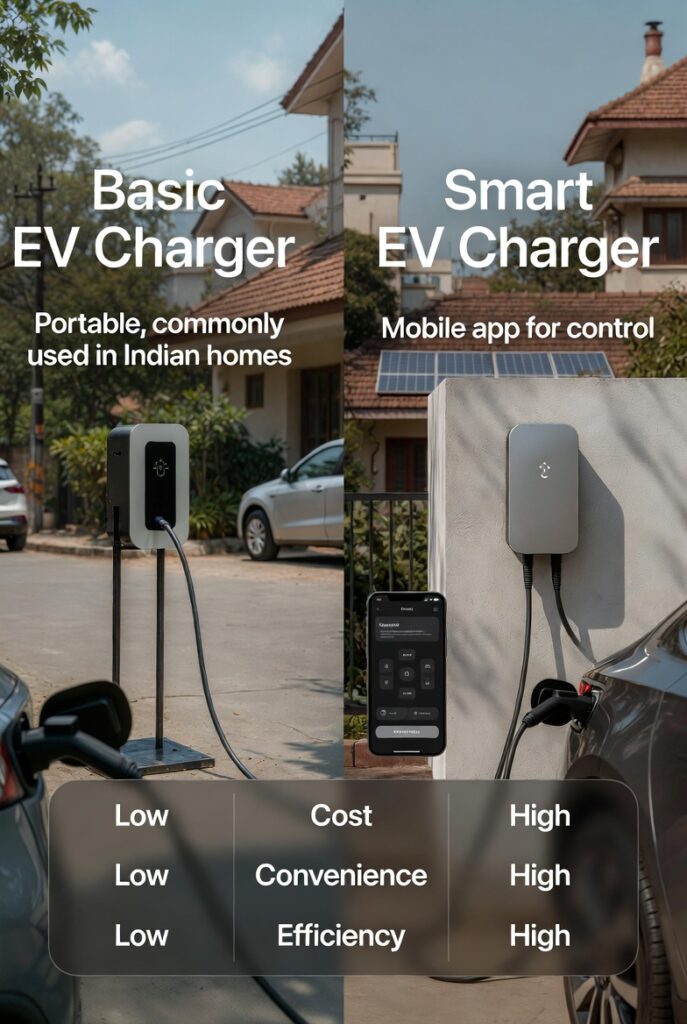
Smart Chargers vs Basic Chargers: Are Advanced Features Worth It?

Planning to buy an EV charger for your home in Bengaluru? Compare smart EV chargers vs basic chargers in India 2026 — cost, features, savings, and solar integration. Smart chargers (Tata Power, Bolt.Earth, Exicom) offer app scheduling, off-peak ToD tariff optimization, load balancing for apartments, and rooftop solar priority — saving ₹8,000–₹20,000+ annually in Karnataka. Basic portable chargers are cheaper (₹10k–₹30k) but miss long-term efficiency. Discover which is worth it for Tata Nexon EV, MG ZS EV, or Mahindra e-Verito owners in Bengaluru’s rising solar & variable tariff landscape.

Scroll to Top